The positioning I wrote that the sales team quietly never used, and what I got wrong
Table of Contents
Stop waiting until launch to figure out your messaging. Learn to build a positioning plan that aligns teams, engages buyers, and drives real business results.
Introduction
Product positioning is hard. Ask most marketing and product teams to rate their positioning out of five, and they usually score themselves a two or a three. The problem often starts because companies create their messaging in a silo. A product marketer sits in a room alone to write it, or a large committee dilutes the message until it loses its edge. This creates a “peanut butter” approach where the text spreads too thin and means nothing to anyone. When you try to appeal to everyone, you end up appealing to no one.

Another common mistake is treating positioning as a final step before launch. Teams build a product and then ask marketing to make it sound good. But positioning should guide product development from the start. If you just slap it on at the end, you end up listing features instead of showing why those features actually matter to a customer.
Clear positioning is more important than ever. Buyers have more choices, and artificial intelligence makes software categories highly saturated. Data from Forrester shows that 94 percent of business buyers now use AI in their buying process. Buyers use conversational search tools to find answers before they ever visit a vendor website. If your message is confusing, buyers will not spend time trying to figure it out. They will just ask an AI tool to find a clearer alternative. This playbook gives you a simple and repeatable method to get your positioning right.
Key Takeaways
- Positioning is the foundation. It determines how your product fits the market and why it is different. Messaging and copy build on top of this foundation.
- Stop waiting for perfect research. Use the triangulation method to combine qualitative quotes, outcome metrics, and behavioral data.
- Do not work alone. Bring product and sales teams into a workshop to agree on your best customers and real alternatives.
- Build a value hierarchy. Connect your features to capabilities before you promise big business outcomes.
- Test your work in the market. Use sales calls, panel research, and website testing to see what actually works.
What Is Product Positioning?
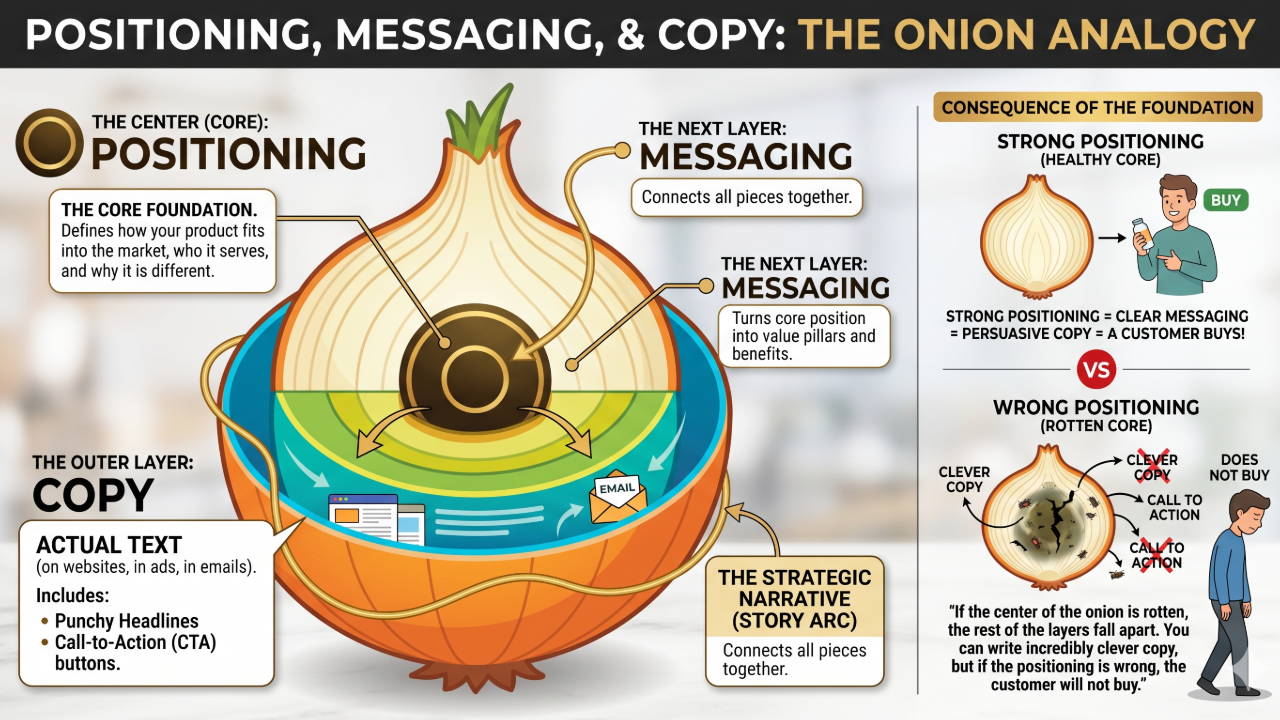
Many people confuse positioning, messaging, and copy. Think of these terms like layers of an onion.
The center of the onion is positioning. This is the core foundation. It defines how your product fits into the market, who it serves, and why it is different.
The next layer out is messaging. Messaging takes your core position and turns it into value pillars and benefits.
The outer layer is copy. Copy is the actual text you see on a website, in an advertisement, or in an email. It includes your punchy headlines and call to action buttons.
Finally, the narrative is the story arc that connects all these pieces together.
If the center of the onion is rotten, the rest of the layers fall apart. You can write incredibly clever copy, but if the positioning is wrong, the customer will not buy. This is why you cannot treat positioning as an afterthought.
Step One: Gather Data Without Analysis Paralysis
When starting a new project, many teams get stuck doing endless research. They think they need fifty customer interviews before they can write a single sentence. This leads to months of wasted time.
You usually have enough data already. The problem is that the data is scattered across different departments. To fix this, use the triangulation method. This means looking at three specific types of data to get an accurate picture.
First, look at qualitative data. This includes what people say in interviews or sales call recordings. You only need a few good calls to surface most of the insights you need. Listen to the exact words your best customers use when they describe their problems.
Second, review outcomes data. Look at churn rates or Net Promoter Scores. This information gives you a directional clue about what makes customers stay or leave. If a specific group of customers never cancels their subscription, you need to study that group closely.
Third, check behavioral data. This shows what users actually do inside your product. Look at feature adoption and usage analytics. For example, you might see that users log in every day but completely ignore your newest reporting tool.
Mixing these three types of data removes bias. It gives you a clear and accurate view of your product without taking months to finish.
Step Two: Run a Cross Functional Alignment Workshop
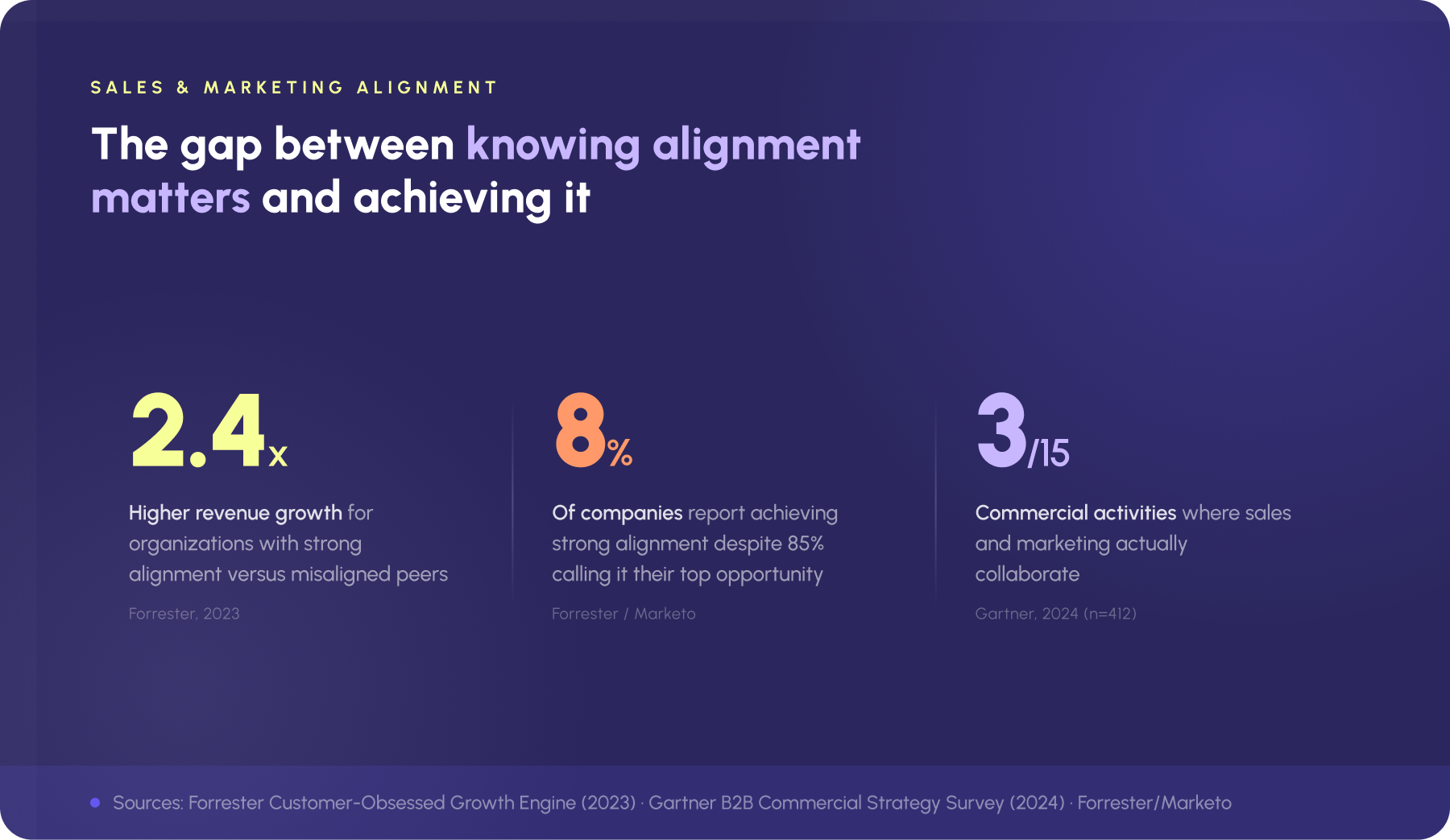
You cannot create positioning alone. You need product managers, sales leaders, and customer success managers in the same room. The goal of this workshop is not just to write a statement. The goal is team alignment.
Research from Gartner shows that buying groups are highly complex, with two to three functional teams contributing to a purchase. If your own internal teams are not aligned, you cannot expect to win over a complex buying committee. Gartner also notes that teams sharing interdepartmental goals are nearly three times as likely to exceed customer acquisition targets.
In the workshop, use forcing questions to get everyone on the same page. Start by identifying your happiest customers. These are the people who get the most value from your product. Then, pinpoint the champion persona who actually signs the contract and drives the deal forward.
Next, define your real alternative. If your product did not exist, what would the customer do? Sometimes the alternative is a direct competitor. Other times, the alternative is a manual spreadsheet or doing nothing at all. For example, if you sell expense tracking software, your biggest competitor might not be another tech company. Your biggest competitor might be a shoebox full of paper receipts.
When you know the real alternative, you can test your differentiators. This shows what truly sets you apart versus what is just a basic requirement to play the game. Doing this live prevents arguments later and keeps everyone focused on the customer.
Step Three: Build Your Value Hierarchy
This is the step where teams experience the biggest breakthrough. A value hierarchy maps your product across four layers: Features, Capabilities, Benefits, and Outcomes.
Most teams try to jump straight from a feature to a big business outcome. For example, they take a feature like an artificial intelligence anomaly detector and immediately promise the outcome of “growing revenue.”
This jump skips the capability layer. The capability is the bridge. It explains what the product actually enables the user to do. In this example, the capability is “automatically identifying unusual data patterns.”
Without that bridge, your promises sound empty. You are telling the customer about the final result without showing them how the product gets them there. When you fill out the value hierarchy, you force the product team to explain the “how” before you promise the “why.”
Here is a simple example of how the matrix works:
- Feature: Automated Data Sync.
- Capability: Moves data from sales to marketing without human effort.
- Benefit: Saves five hours a week and reduces typing errors.
- Outcome: Lowers customer acquisition costs and increases profit margins.
By filling out each step, your messaging becomes logical and easy to believe.
Step Four: Validate Your Hypothesis in the Real Market
Positioning is a hypothesis. It is an educated guess, not a set of facts. You must test it to see if it actually works in the real world.
There are three main ways to validate your work:
First, have the sales team use the new messaging directly in their deals. Ask them to report back on what resonates with the buyer and what causes confusion. If a certain phrase makes buyers tilt their heads in confusion, cut it immediately.
Second, use panel research tools. Platforms like Wynter allow you to get direct feedback from your specific target audience very quickly. You can put your new messaging in front of real buyers and ask them if it makes sense.
Third, run direct channel tests. A/B test your email copy or try different website headlines. A/B testing simply means sending version A to half your audience and version B to the other half. You then measure which version gets more clicks or replies.
The key here is speed. The market will tell you what works much faster than any internal debate. According to Forrester, 81 percent of buyers express dissatisfaction with the winning provider in a recent business purchase. If your message is clear and tested, you stand a much better chance of keeping buyers happy and confident in their choice.
Step Five: Create Derivative Assets for Team Enablement
A common complaint from product marketers is that they do all this work, but the sales team just goes back to using their old pitch decks.
To prevent this, you must create derivative assets. You cannot hand over a massive strategy document and expect people to read it. You need specific tools for specific teams.
For the marketing team, create a copywriting guide. Include exact phrases of what to say and what not to say. For example, tell them to say “automated data sync” instead of “magic data transfer.”
For the product team, provide an insights brief. This document should inform their future roadmap decisions by showing them exactly what the customer values most.
For the sales team, develop a clear talk track. Include objection handling points and specific proof points. If a customer says your product is too expensive, the talk track gives the sales rep the exact words to prove the product’s value.
When you make their jobs easier, they are much more likely to use the new messaging. This turns product marketing from a simple support function into a true business partner. You earn a seat at the table by bringing clarity to the chaos and proving that a product cannot succeed without clear positioning.
Conclusion
Getting your product positioning right is hard work, but it pays off. By gathering the right data, aligning your internal teams, and building a logical value hierarchy, you can cut through the noise. Testing your messaging in the market ensures that you are actually reaching buyers. Finally, giving your teams the exact tools they need guarantees that your new messaging actually gets used. Stop waiting for the end of the product cycle. Start positioning early and watch your revenue grow.
Frequently Asked Questions
What is the difference between positioning and messaging?
Positioning is the core foundation that defines your market category, target audience, and competitive advantage. Messaging is how you communicate that position through specific value pillars, benefits, and talking points.
How do you gather data for product positioning quickly?
Use the triangulation method. Combine a small number of qualitative customer interviews with outcome data, like churn rates, and behavioral data, like feature usage metrics. This gives you an accurate picture without taking months.
What is a value hierarchy?
A value hierarchy is a framework that maps your product across four levels: Features, Capabilities, Benefits, and Outcomes. It ensures you explain how a feature works before you promise a massive business result.
Why do teams fail at positioning?
Teams often fail because they create messaging in isolation, try to please everyone in a large committee, or wait until the product is already built to start thinking about the target audience.
How can I make sure my sales team uses the new messaging?
Do not just give them a long reference document. Create specific derivative assets like talk tracks, objection handling guides, and ready to use email templates that make their daily jobs easier.
References
- The Growth Syndicate. “The complete guide to sales and marketing alignment for B2B revenue growth.” Citing Gartner research on interdepartmental KPIs.
- Forrester Research. “B2B Buyers Make Zero Click Number One” (January 2026). Data on AI usage in the buying process.
- Forrester Research. “B2B Marketing Strategy.” Data on buyer dissatisfaction rates post purchase.
- The Courageous Careers Interview Series: “The Five Step Product Positioning Playbook.”
-
Demand Generation Isn't About Getting More Leads
-
How I Build a GTM Strategy Without a Huge Marketing Team
-
Why Marketing and Sales Keep Blaming Each Other.
-
The ICP vs. Buyer Persona Mistake I See All the Time.
-
Product Led or Sales Led? Here's How I Think About It.
Recent posts:
Author

Rosi
Head of Marketing
Go-To-Market • Content • Growth