A lead number can double while pipeline stays flat. What demand generation is actually for, and the four things worth measuring instead of lead volume.
Table of Contents
Introduction
Demand generation is not a lead volume problem. It is the work of making buyers want you before they start shopping, and then making it easy for them to buy when they finally do. Leads are one output of that work, and a late one. If your only goal is more of them, you will hit the goal and still miss the number.
I learned this in a Monday meeting. I had a slide with a lead count on it, and the count was roughly double the month before. I was pleased with myself for about forty seconds. Then the person running sales asked which of those people had a budget, and I did not have an answer. We had not created any new demand that month. We had just put a gate in front of a piece of content that people wanted, and counted the people who walked through it.
That is the trap. Lead volume is the easiest thing in marketing to move and the easiest thing to fake. It feels like progress because it is a bigger number, and bigger numbers are how most of us were taught to prove we did something.
Key Takeaways
- Demand generation has two jobs: create demand from people who are not looking yet, and capture it cleanly when they start.
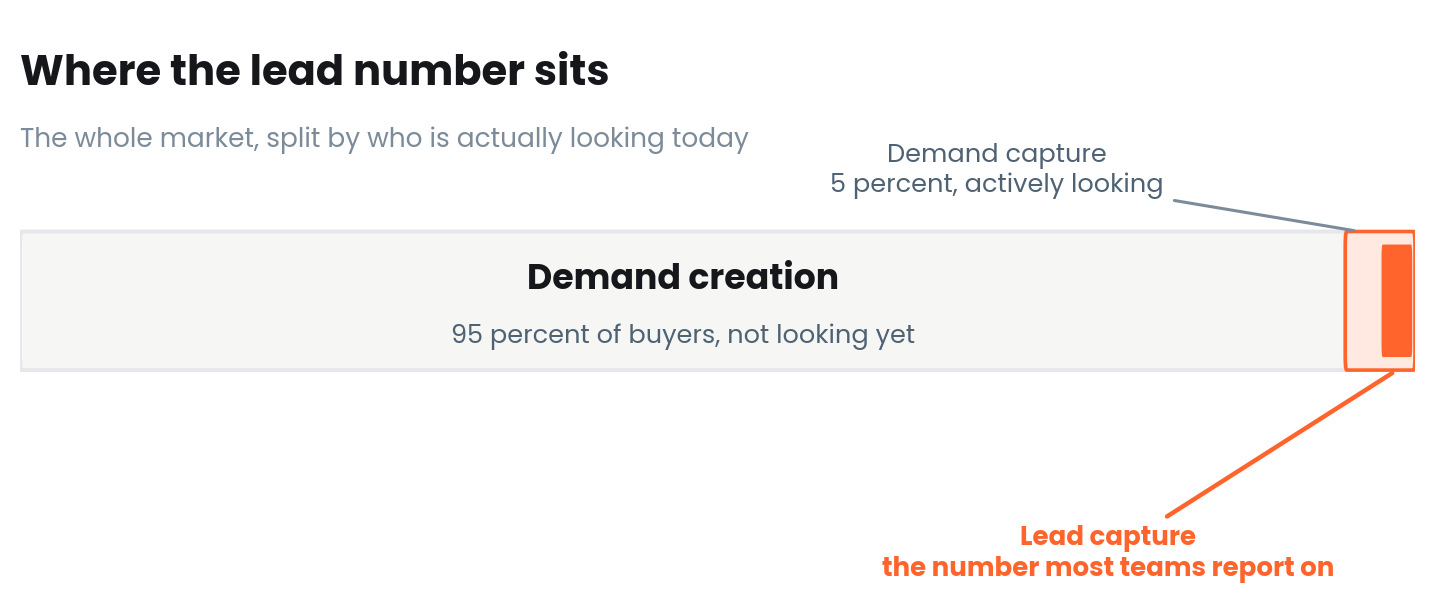
- Up to 95 percent of business buyers are not in the market for a given product at any one time, according to Professor John Dawes at the Ehrenberg-Bass Institute (2021). Only about 20 percent buy in a given year.
- Bain & Company found in 2025 that 85 percent of B2B buyers purchase from their day one list, meaning the vendors they already had in mind before they searched.
- Average lead to close conversion sits between 0.5 and 1 percent, per Forrester. At that rate, 1,000 leads is five to ten deals.
- The useful question is not how many leads you got. It is whether a buyer wrote your name down on day one, before they talked to anyone.
- Better measures: shortlist presence, self reported source on real opportunities, deal velocity, and the share of deals that arrive already convinced.
Why “more leads” became the goal in the first place
Because leads are countable, and almost nothing else in early stage marketing is.
Think about what a small marketing team can actually report on in month three. Not brand awareness. Not consideration. Not the conversation two buyers had about you in a private Slack group. You can count form fills. So form fills become the goal, then the target, then the thing your quarter is judged on. Nobody decided this on purpose. It is just the only number that showed up on time.
The trouble is that the metric then starts steering the work. You pick the channel that produces the most form fills per euro. You gate the content that would have travelled further ungated. You buy a list. Six months later you have a large database and a flat pipeline, and the sales team has quietly stopped calling anything marketing sends over. I have written about where that mistrust comes from, and it almost always starts here.
What demand generation actually is
Demand generation is the full set of activity that creates interest in a category and a preference for you inside it, then converts that preference into revenue.
Two halves, and most teams only run one:
Demand creation
Making someone want a thing they were not looking for this morning. Point of view content, a founder saying something specific in public, a podcast, a community, a talk, an ad that a buyer remembers eleven months later when the problem finally hurts. This half is slow and hard to attribute and it is where almost all the compounding lives.
Demand capture
Being findable, clear, and easy to buy from at the moment someone starts looking. Search, comparison pages, pricing that exists, a demo request that does not take nine fields. This half is fast, measurable, and finite. You can only capture demand that already exists.
If you want the longer version of this split, I wrote a full piece on how I think about demand generation. The short version for this article: lead capture is a small piece of the second half. That is all it is.
The math that breaks the lead goal
Run the numbers once and the goal stops making sense.
Say your market is 10,000 companies. Ehrenberg-Bass says about 5 percent are in market this quarter, so 500 of them. Your website converts, and you generate 1,000 leads in the quarter. At Forrester’s 0.5 to 1 percent lead to close rate, that is five to ten new customers.
Now double the leads. You get ten to twenty. Progress, technically. But you did nothing at all for the 9,500 companies who were not buying this quarter and will be buying next year, and those are the ones who decide whether you exist in their head when the time comes. Doubling a 1 percent conversion rate on a shrinking pool is a treadmill, and the treadmill gets faster every quarter because your competitors are on the same one.
The other half of the market is not a nurture problem. It is a memory problem.
The Shortlist Test
Here is the one question I use to sort demand gen work from busywork.
When this buyer sat down and wrote three vendor names on a page, before they searched for anything, were you one of the three?
That is the whole test. Every piece of marketing either moves you closer to being on that page or it does not.
It is a fair test because the shortlist is where the deal is mostly decided. 6sense surveyed nearly 4,000 B2B buyers in 2025 and found they fill about four spots on a day one shortlist and then buy from one of those four 95 percent of the time. They also do not talk to a seller until they are about 61 percent of the way through the process. So by the time a person becomes a “lead” in your system, most of the decision has happened somewhere you could not see.
Apply the test to a few real activities:
A webinar with 300 registrants where 280 came from a paid list. Nobody who did not already know you learned your name in a way they will keep. Fails.
A gated report that a buyer downloaded, skimmed, and forgot, and now gets five emails. Fails, and slightly damages you.
An honest post about a mistake you made, which a buyer read, disagreed with half of, and remembered. Passes.
A comparison page that a buyer finds at week six of a ten month evaluation, which answers the objection their CFO raised. Passes, on the capture side.
The test is uncomfortable because a lot of activity fails it. That is the point. It is easier to defend a smaller plan when you can say out loud why the other things do not count.
What to measure instead of lead volume
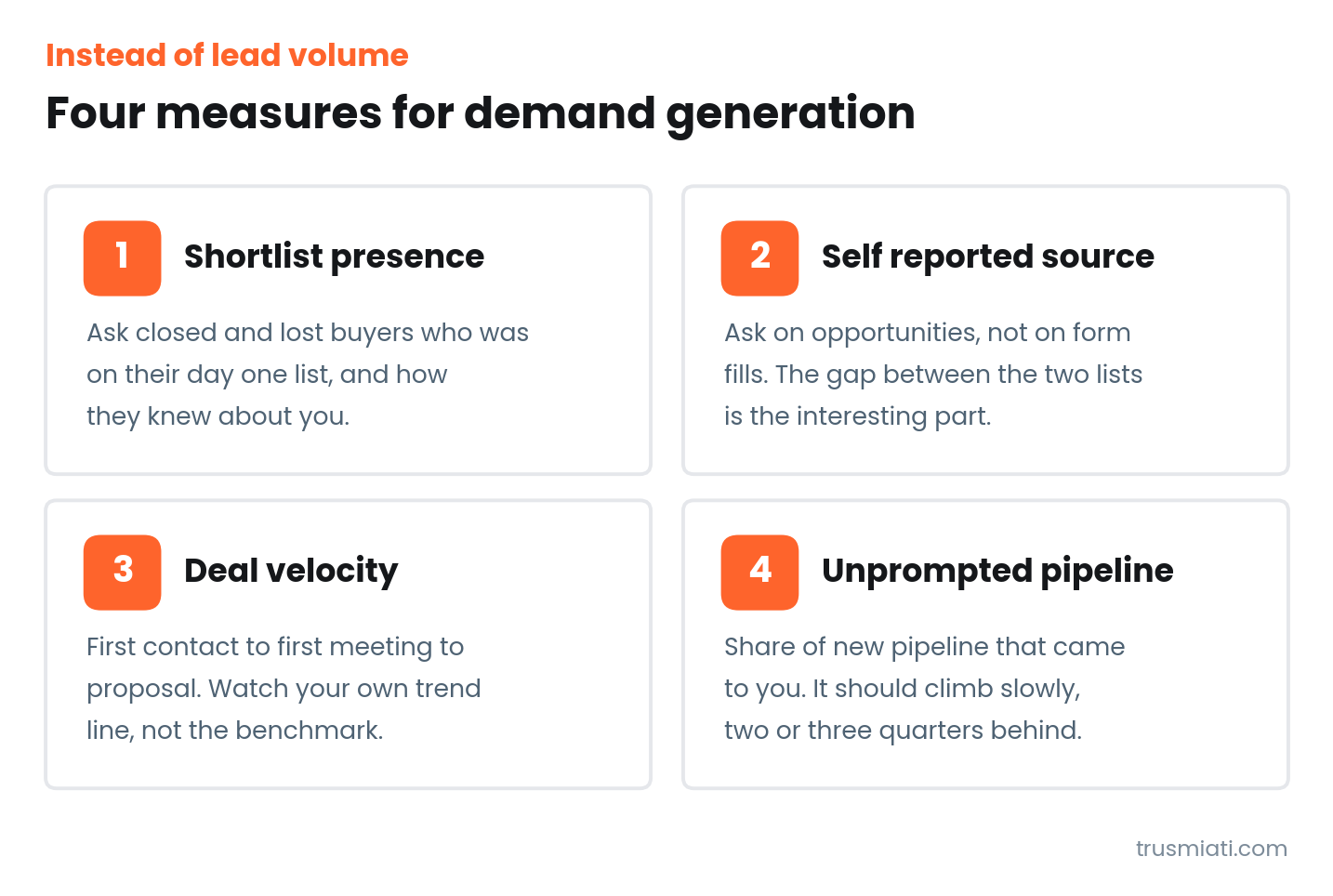
Replace one big number with four smaller ones you can actually act on. None of these require a new tool.
1. Shortlist presence
On every closed opportunity, won or lost, ask the buyer one question: which vendors were on your list at the start, and how did you know about us? Log the answer as free text. After twenty deals you have something no dashboard gives you. This is qualitative and small and it beats attribution software for this specific question.
2. Self reported source on real opportunities
Not on leads. On opportunities. A “how did you hear about us” field on the form nobody serious fills in tells you about form fillers. The same question asked on a discovery call tells you what created the demand. The gap between the two lists is usually the most interesting thing you will learn all quarter.
3. Deal velocity and the shape of the first call
Time from first contact to first meeting, and time from first meeting to proposal. When demand creation is working, deals move faster because the buyer arrives already convinced of the category and half convinced of you. A shorter first call is a marketing result even though it looks like a sales one. 6sense measured average buying cycles compressing from 11.3 months in 2024 to 10.1 months in 2025, so the benchmark moves. Track your own trend line rather than the industry one.
4. Share of pipeline that arrived unprompted
Inbound demo requests, warm intros, “we have been reading your stuff for a year” emails. Count them as a percentage of new pipeline, not as an absolute. It should climb slowly and it will lag your work by two or three quarters. If it never climbs, your demand creation is not landing, no matter how good the content looked internally.
A worked example
Two teams, same product, same twelve months, same budget. This is a hypothetical to show the shape of the thing, not a case study.
Team A sets a goal of 4,000 leads. They gate everything, buy two list based webinars, and run search ads on high intent keywords. They hit 4,100 leads. At 0.75 percent, that is about 31 customers. Sales complains about quality all year. In month twelve, marketing needs another 4,000 leads to do it again, and the cheap sources are used up.
Team B sets a goal of being on the day one list in one narrow segment. They publish forty pieces from real customer conversations, put the founder on eleven podcasts in that segment, and build three comparison pages and a pricing page. They generate 900 leads, which looks terrible on a slide. But 22 of those are inbound demo requests from companies who already knew the category, they close at 12 percent because the buyer arrived convinced, and the average deal is larger because they were not competing on price against four vendors the buyer found on the same day.
Team B ends the year with fewer leads and roughly the same number of customers. The difference is what happens in month thirteen. Team A starts from zero again. Team B starts with a segment where a decent share of buyers can name them without prompting, and that stock does not reset.
That is the actual argument for demand generation. Not that leads are bad. That leads do not accumulate, and preference does.
What this changes about your week
Small and specific, because the strategy only matters if the calendar changes.
Stop reporting lead count as the headline number. Move it to a supporting line where it belongs, next to cost per lead, and put pipeline created and shortlist presence at the top.
Ungate at least one thing that was gated. Pick the asset with the highest read time and the lowest conversion, because that is the one people want and the gate is costing you reach.
Add the shortlist question to your discovery call template this week. It takes one line and one prompt to whoever runs the call.
Pick one segment, not four. When you are the only marketer, being memorable in one narrow place beats being invisible in four. That is the same logic behind building a go to market plan without a big team, and it depends on having done the work on who you are actually for first.
And give it three quarters before you judge it. Demand creation pays back on a delay. If you kill it at week eight because the lead number dipped, you will have paid the cost and collected none of the return, which is the worst of both options.
Conclusion
The lead number is not the enemy. Treating it as the goal is.
Demand generation is about being the name a buyer already has in their head on the day the problem becomes urgent. You cannot buy that in a quarter and you cannot count it in a form fill. You can only build it, slowly, by saying specific true things in places your buyer already is, and then making it easy to buy when they turn up.
So the next time someone asks for more leads, ask them what they think the leads are for. Usually the honest answer is pipeline. Then you can have a much better conversation about how to get it.
Frequently Asked Questions
What is demand generation?
Demand generation is the marketing work that creates interest in a problem or category and builds preference for one vendor inside it, then converts that preference into revenue. It has two halves: demand creation, aimed at buyers who are not looking yet, and demand capture, aimed at buyers who have started looking. Lead capture is one small part of the second half.
Is demand generation the same as lead generation?
No. Lead generation collects contact details from people who are already looking, usually behind a form. Demand generation creates the want in the first place, including among people who will not buy for a year or more. A team can run excellent lead generation and produce no new demand at all, which is what happens when the lead number rises and pipeline stays flat.
Why is lead volume a bad marketing goal?
Because it is easy to move without creating any value. Gating more content, buying lists, and running broad paid campaigns all raise lead volume while lowering quality. Forrester puts average lead to close conversion at 0.5 to 1 percent, so 1,000 extra leads is often five to ten extra customers, and the leads do not carry over to next quarter. Preference does.
What should you measure instead of leads?
Four things. Shortlist presence, which you get by asking closed and lost buyers which vendors were on their list on day one. Self reported source captured on opportunities rather than on form fills. Deal velocity, meaning time from first contact to first meeting to proposal. And the share of new pipeline that arrived unprompted. All four can be tracked without buying software.
How long does demand generation take to work?
Demand creation typically shows up in pipeline after two to three quarters, because you are waiting for buyers to enter the market rather than persuading the ones already in it. Ehrenberg-Bass research puts only about 20 percent of business buyers in market in a given year. Demand capture works much faster, often within weeks, but it is limited to the demand that already exists.
Can a small team do demand generation?
Yes, and arguably better, as long as the segment is narrow enough. A team of two can be memorable to 500 companies. It cannot be memorable to 50,000. The constraint is not budget, it is how many different audiences you are trying to reach at once. Pick one, say something specific, and repeat it longer than feels comfortable.
Does demand generation still matter now that buyers use AI search?
It matters more. Bain found in 2025 that click through rates have fallen by as much as 30 percent in some categories including B2B software, as buyers get their answer from an AI summary and never click. If buyers are seeing fewer of your pages, the name they already trust carries more of the decision. Being on the day one list is the part AI search cannot take away from you.
-
How I Build a GTM Strategy Without a Huge Marketing Team
-
Why Marketing and Sales Keep Blaming Each Other.
-
The ICP vs. Buyer Persona Mistake I See All the Time.
-
Product Led or Sales Led? Here's How I Think About It.
-
What I Learned About Product Marketing After Working in B2B SaaS.
Recent posts:
Author

Rosi
Head of Marketing
Go-To-Market • Content • Growth