Everyone builds an ICP first. Here is why I build it third, and what I build instead
Table of Contents
Learn the real difference between an ideal customer profile and a buyer persona, and stop mixing up the two most useful targeting tools you have.
Introduction
Here is a mistake I see all the time. A team says they have an ideal customer profile. You ask to see it, and they hand you a document that describes a 38-year-old marketing manager named “Marketing Mary” who likes coffee and hates spreadsheets.
That is not an ideal customer profile. That is a buyer persona. And confusing the two costs you money.
The two tools do different jobs. One picks the companies you should be selling to. The other describes the humans inside those companies so you can talk to them well. When you mix them up, you either chase the wrong accounts or write messages that speak to no one in particular.
Today I want to clear this up for good. I will define both terms in plain language, show you when to use each, and walk you through how they work together. By the end, you will know exactly which one you need and why you actually need both.
Key Takeaways
- An ICP is about the company. Your ideal customer profile describes the type of organization that gets the most value from you and gives you the most value back.
- A buyer persona is about the person. A persona describes a human inside that company: their role, their goals, and what keeps them up at night.
- ICP comes first. You pick the right companies, then you map the people inside them. Doing it the other way around wastes effort.
- You need more than one persona. A typical B2B deal now involves six to 10 decision makers, so one company holds several personas at once.
- Firmographics vs. psychology. ICPs are built from facts about a business (size, industry, tech). Personas are built from what a person wants, fears, and believes.
- Clarity converts. When your ICP is tight and your personas are real, every ad, email, and sales call gets sharper.
What Is an Ideal Customer Profile (ICP)?
An ideal customer profile is a description of the company that is the perfect fit for what you sell. Not a good-enough fit. The perfect one.
Think of it as a filter. Out of every business that could possibly buy from you, your ICP describes the slice that gets the fastest results, sticks around the longest, and costs you the least to serve. These are the accounts where everything just clicks.
An ICP is built from firmographics. That is a fancy word for plain facts about a business. Things like:
- Industry. Software, healthcare, manufacturing, and so on.
- Company size. Number of employees or annual revenue.
- Location. The regions you can actually serve well.
- Tech stack. The tools they already use that your product plugs into.
- Growth stage. Early startup, scaling, or mature enterprise.
- Trigger events. A new funding round, a new VP of Sales, a recent expansion.
Notice what is missing from that list. No names. No personalities. No individual job titles. An ICP does not care who works there yet. It only cares whether the company itself is a match.
Here is the test I use. If you can point at a company and say “yes, that one is exactly right for us” without knowing a single person who works there, you have an ICP.
What Is a Buyer Persona?
A buyer persona is a description of a specific person inside the companies you sell to. It is a semi-fictional profile of a real type of human who influences the buying decision.
Where the ICP zooms out to the whole business, the persona zooms in to one desk. It answers a different question. Not “is this the right company” but “who is this person, and how do I talk to them so they listen”.
A good persona covers things like:
- Job title and role. What are they responsible for?
- Goals. What does success look like for them this quarter?
- Pain points. What is frustrating or scary about their job right now?
- How they are measured. What number does their boss judge them on?
- Where they hang out. LinkedIn, industry Slack groups, certain newsletters.
- Objections. Why might they say no, even when the fit is good?
This is where “Marketing Mary” actually belongs. Personas can have names and personalities, because their whole point is to make an abstract job title feel like a real human you are writing to.
But here is the part most people miss. You do not get one persona per company. You get several. Research from Gartner shows that a typical buying group for a complex B2B purchase involves six to 10 decision makers, each carrying their own priorities and their own reasons to hesitate.
So one company on your ICP list might hold a champion, an economic buyer, a technical gatekeeper, and an end user. Four personas, one account. Each one needs a slightly different message.
ICP vs. Buyer Persona: The Core Difference
Let me put the two side by side, because seeing them together makes the difference obvious.
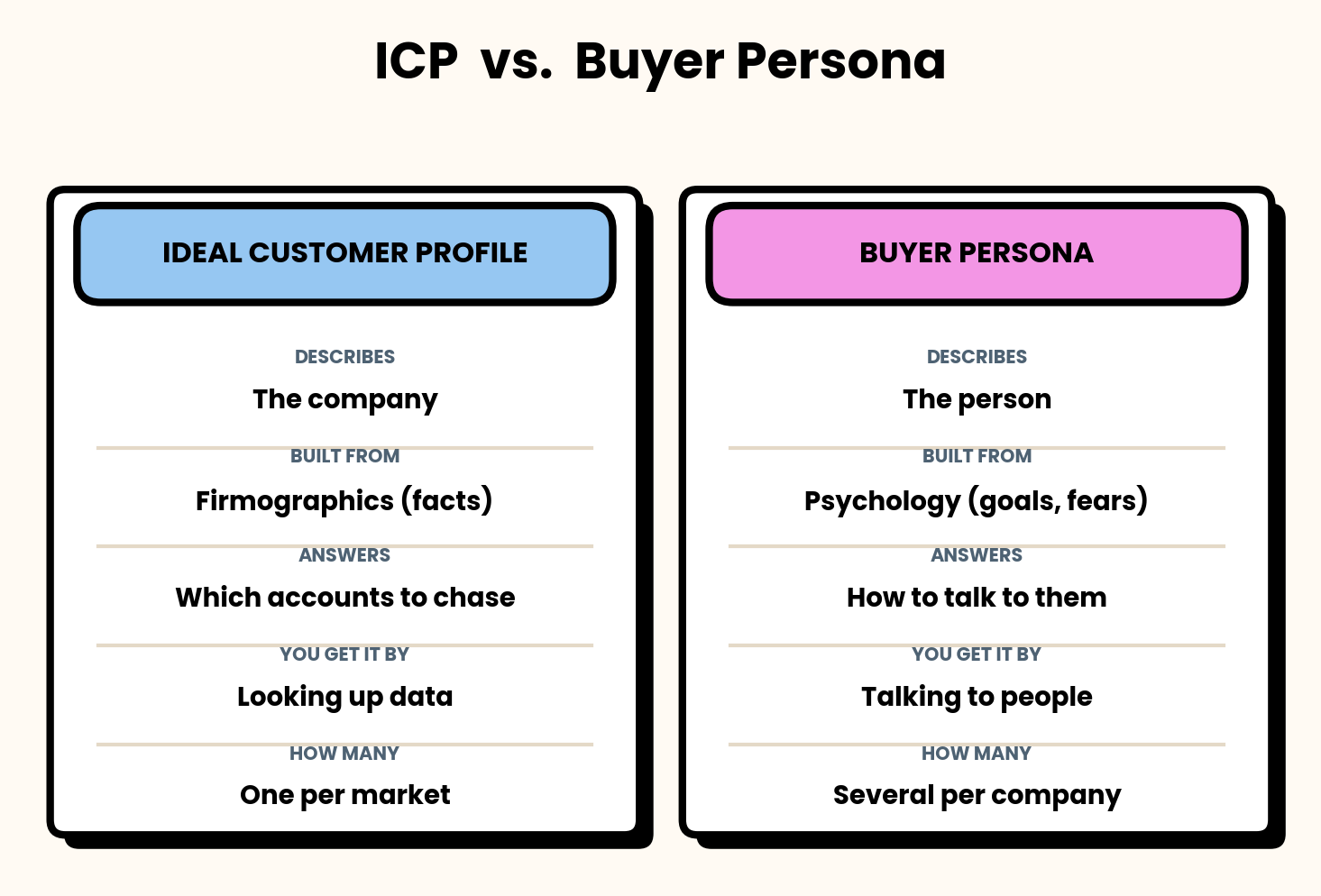
The shortest way to say it: your ICP is the company you want to win, and your buyer persona is the person you have to convince.
They are not competitors. They are two layers of the same targeting system. The ICP draws the boundary around the market worth chasing. The personas fill in the humans inside that boundary.
One more way to feel the difference. An ICP is mostly facts you can look up. Revenue, headcount, industry, tools. A persona is mostly psychology you have to learn. Fears, goals, pressures, biases. That is why you research an ICP with data and you research a persona by actually talking to people.
When to Use Your ICP
Use your ICP whenever the question is “who should we go after”. It is a strategy tool. It works at the level of markets and accounts, not individual emails.
Reach for your ICP when you are:
- Building a target account list. Sales needs to know which logos to chase. The ICP is that list’s filter.
- Deciding where to spend budget. You point ads and outbound at ICP-fit companies instead of spraying the whole market.
- Qualifying inbound leads. A demo request from an ICP-fit company jumps the line. One from a bad fit gets a lighter touch.
- Planning your go-to-market motion. Your whole go-to-market playbook should be built around the companies in your ICP.
If you get the ICP wrong, everything downstream gets more expensive. You end up paying to reach companies that were never going to buy, or that buy once and churn in three months. A tight ICP is the cheapest efficiency lever you have.
When to Use Your Buyer Personas
Use your personas whenever the question is “what do I actually say”. Personas are a messaging tool. They live at the level of the individual email, ad, landing page, and sales call.
Reach for a persona when you are:
- Writing copy. The same product benefit gets framed differently for a CFO than for an end user. The persona tells you which frame to pick.
- Building content. A blog post for a hands-on practitioner and a one-pager for an executive are not the same document.
- Prepping a sales call. Knowing the persona means the rep walks in already understanding what this person is measured on and afraid of.
- Handling objections. Each persona says no for different reasons. Personas let you answer the objection before it is even spoken.
This is also where personas connect to demand generation. You cannot build real desire in a buyer you do not understand. Personas are how you make sure your content lands on the right fears and hopes instead of talking past everyone.
How ICP and Personas Work Together
Here is the order that actually works. ICP first, personas second. Every time.
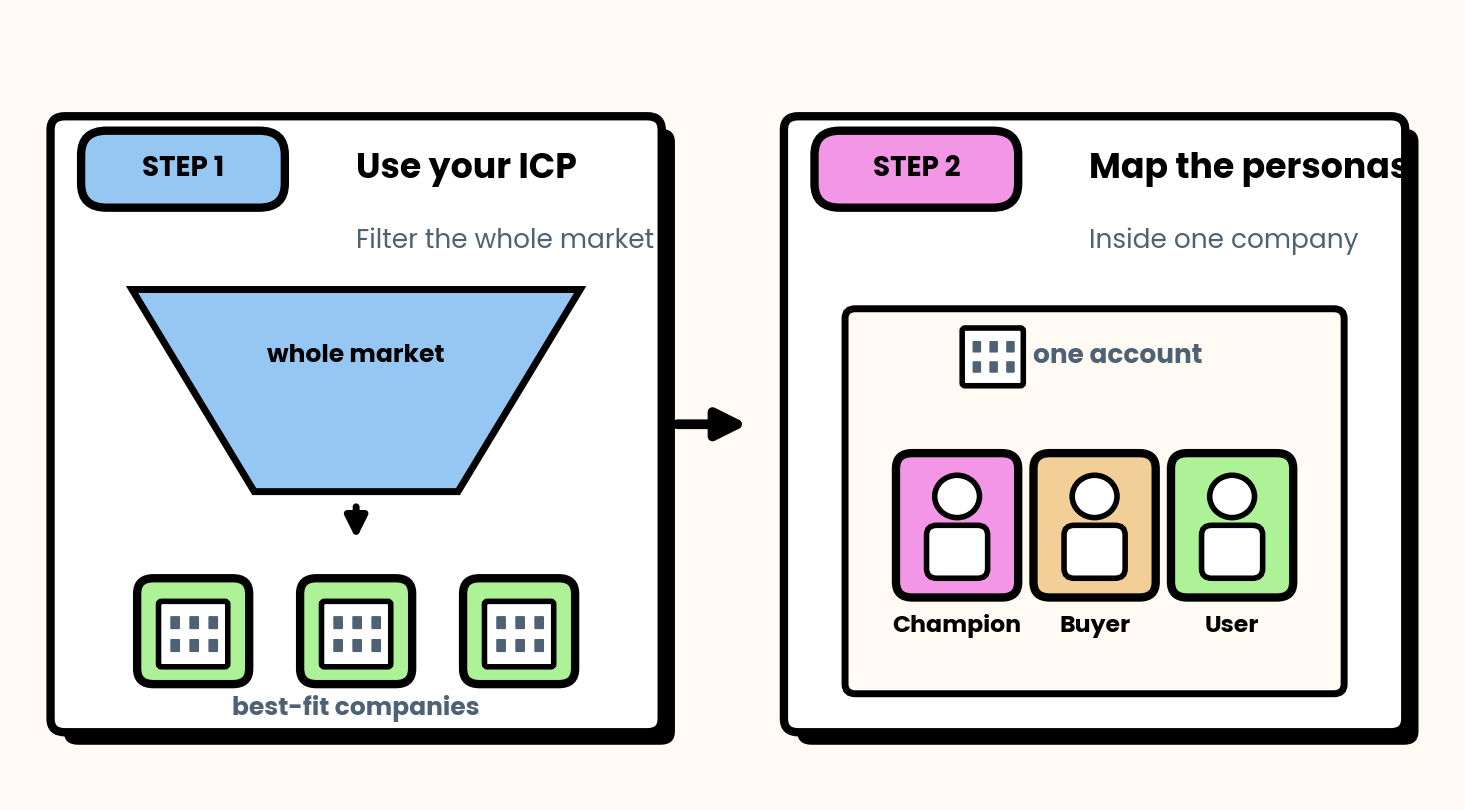
Think of it like fishing. Your ICP tells you which lake to fish in. Your personas tell you which bait works for which fish once you are there. Show up at the wrong lake with perfect bait and you still catch nothing.
Step one, you use your ICP to draw up the list of companies worth pursuing. This narrows a giant market down to the accounts where you can actually win.
Step two, for each of those companies, you map the buying group. Who are the six to 10 people who will shape this decision? You match each of them to a persona so you know how to reach and convince them.
Skip step one and you build beautiful personas for companies that will never buy. Skip step two and you land on the right company but send one generic message that speaks to no one. You need both, in that order.
A Worked Example
Let me make this concrete. Say you sell an analytics tool for e-commerce brands.
Your ICP might look like this:
- Online retail companies
- Between 50 and 500 employees
- Doing more than 10 million dollars in annual revenue
- Already using Shopify
- Based in North America or Europe
That profile does not name a single person. It just tells your team which companies are worth a real push. A 12-person startup on a different platform gets filtered out before anyone wastes a call on them.
Now, inside one of those companies, you might map three personas:
- The Head of E-commerce (the champion). Measured on revenue growth. Wants a tool that proves its impact fast. Fears buying something the team never actually adopts.
- The Data Analyst (the end user). Measured on getting clean reports out on time. Wants something that saves hours of manual work. Fears a clunky tool that creates more busywork.
- The CFO (the economic buyer). Measured on margins. Wants a clear return on the spend. Fears signing off on software that quietly gets abandoned.
Same company. Same deal. Three completely different conversations. The champion needs a story about growth. The analyst needs a demo of time saved. The CFO needs a number.
That is the whole point. The ICP got you into the right room. The personas tell you what to say to each person once you are in it.
Conclusion
So which one do you need, an ICP or a buyer persona? Both. They are not rivals. They are a set.
Your ideal customer profile is your filter for which companies deserve your time and money. Your buyer personas are your guide for how to talk to the real humans inside those companies. Get the ICP right and you stop wasting effort on accounts that were never going to buy. Get the personas right and your message actually lands when you get there.
If your targeting feels fuzzy right now, start with the ICP. Write down the traits of your best five customers and look for the pattern. Then, inside those accounts, name the people who shape the decision and learn what each one really wants.
Clarity converts. When you know exactly who you are for and exactly who you are talking to, everything downstream gets easier.
Frequently Asked Questions
What is the difference between an ICP and a buyer persona?
An ideal customer profile describes the type of company that is the best fit for your product, using facts like industry, size, and tech stack. A buyer persona describes an individual person inside that company, including their role, goals, and pain points. In short, the ICP is the company and the persona is the person.
Which comes first, ICP or buyer persona?
The ICP comes first. You use it to decide which companies are worth pursuing, then you build personas for the specific decision makers inside those companies. Building personas before you have an ICP means you might describe people at companies that will never buy from you.
Can a company have more than one buyer persona?
Yes, almost always. A typical B2B purchase involves six to 10 decision makers, according to Gartner, so a single account usually holds several personas at once. You might have a champion, an economic buyer, and an end user inside the same company, and each one needs a different message.
Is a buyer persona the same as a target audience?
No. A target audience is a broad group, like “marketing leaders at mid-size companies.” A buyer persona is a detailed, semi-fictional profile of one specific type of person within that audience, including their goals, fears, and how they are measured. The persona is much more specific and is built to guide your actual messaging.
Do small businesses need both an ICP and personas?
Yes, and often they benefit the most. Small teams have the least time and money to waste, so a tight ICP keeps them from chasing bad-fit accounts. Even a simple one-page ICP and two or three basic personas will sharpen every message and save real effort.
What is firmographic data?
Firmographic data is factual information about a company rather than a person. It includes things like industry, number of employees, annual revenue, location, and the software the business uses. Firmographics are the raw material you use to build an ideal customer profile.
-
Demand Generation Isn't About Getting More Leads
-
How I Build a GTM Strategy Without a Huge Marketing Team
-
Why Marketing and Sales Keep Blaming Each Other.
-
Product Led or Sales Led? Here's How I Think About It.
-
What I Learned About Product Marketing After Working in B2B SaaS.
Recent posts:
Author

Rosi
Head of Marketing
Go-To-Market • Content • Growth