A lean go to market strategy is five decisions made in order. Here is the sequence I use, what I skip, and how I measure it when attribution is a spreadsheet.
Table of Contents
A lean go to market strategy is not a smaller copy of a big one. It is a different shape.
Introduction
The first go to market plan I ever owned had three people attached to it. One of them was me. The product took the founders four minutes to explain, and they still lost the room at minute two.
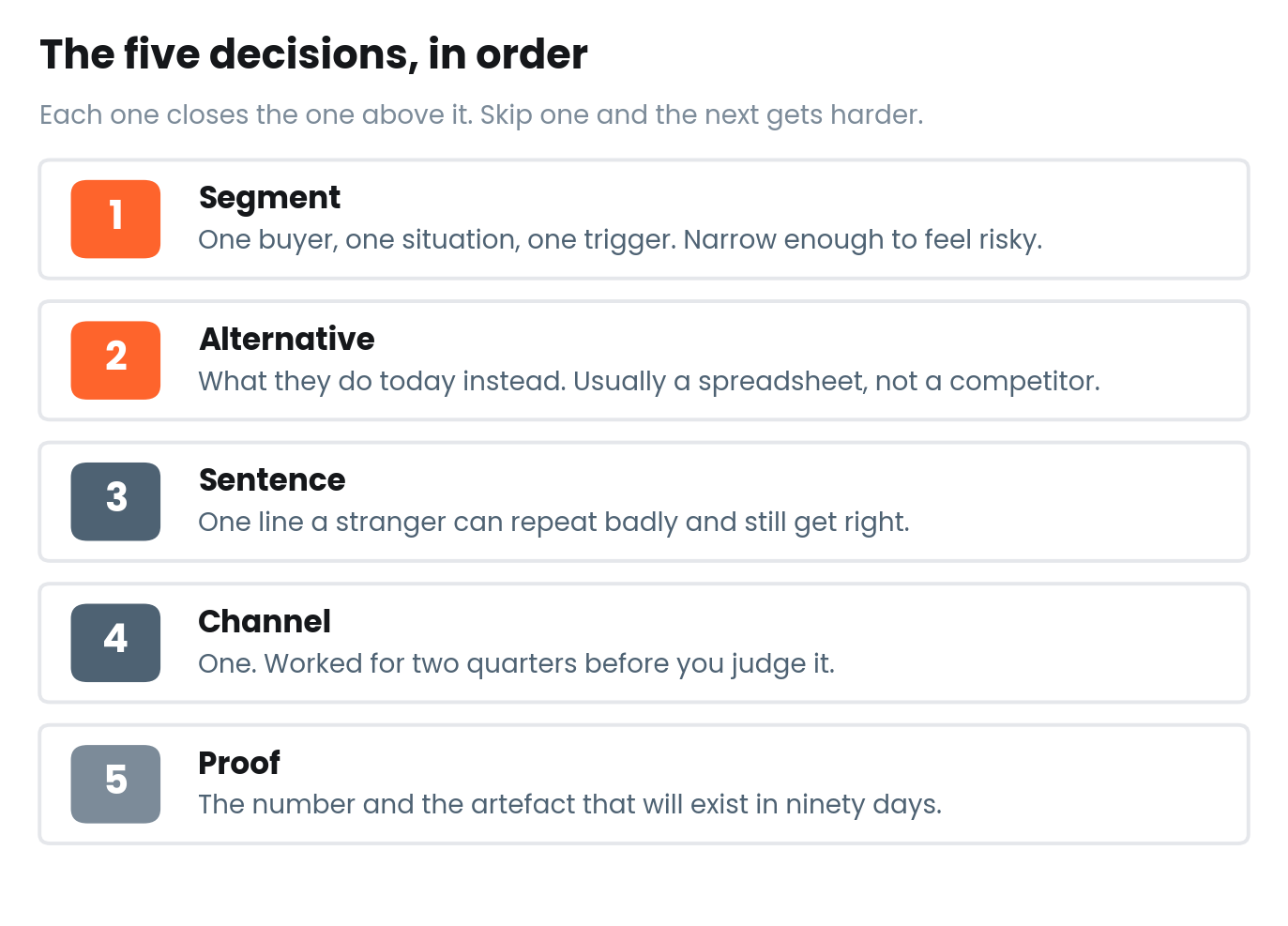
A lean go to market strategy is a sequence of five decisions made in order: who you are for, what you replace, the one sentence a stranger can repeat, the one channel you will actually work, and the proof you will have in ninety days. It wins by subtraction. A small team rarely loses to a big team on budget. It loses on scatter.
Most GTM advice assumes a function that already exists. A demand gen person, a content person, a designer, someone in ops, someone who owns the number. If that is your situation, this is not for you. This is for the person who is all of those at once and has to decide on Monday morning what not to do.
I have built marketing from nothing three times now. The plan gets shorter every time.
Key Takeaways
- A lean go to market strategy is a sequence, not a menu. Five decisions in order: segment, alternative, sentence, channel, proof. Doing them out of order is the most common failure.
- Marketing budgets sat flat at 7.7 percent of company revenue in 2025, according to the Gartner 2025 CMO Spend Survey of 402 marketing leaders. Working under-resourced is the normal condition, not a temporary one.
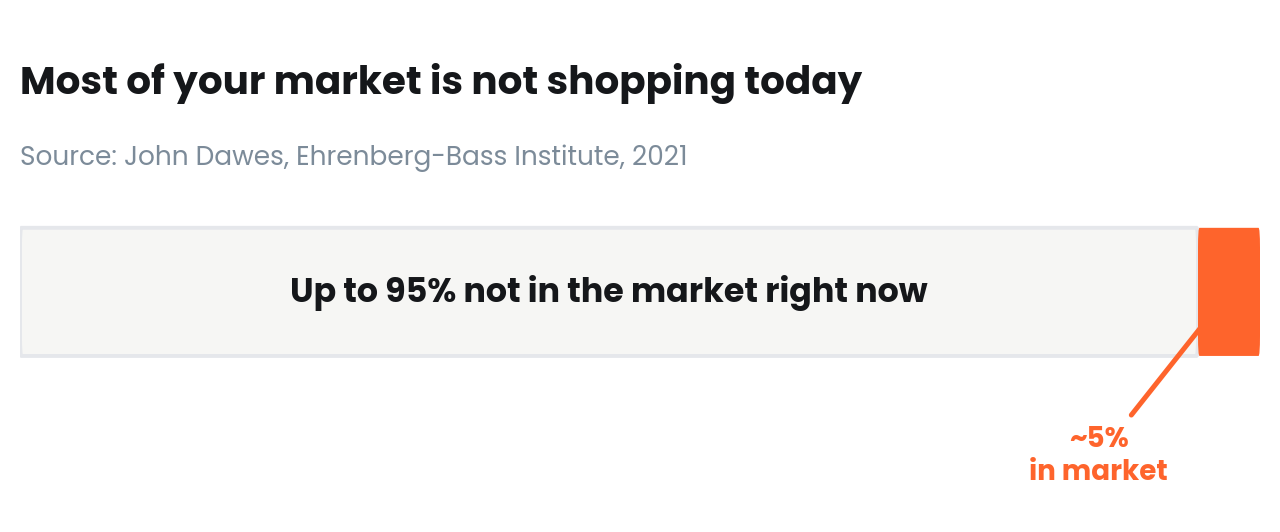
- Up to 95 percent of business buyers are not in the market at any given moment, per John Dawes at the Ehrenberg-Bass Institute (2021). A lean plan has to work on people who are not buying today.
- 90 percent of B2B buyers choose a vendor that was already on their shortlist at the start of the process, from Bain and Google research published in HBR in 2022 (1,208 respondents). Being remembered beats being findable.
- Buying groups now run 5 to 16 people across up to four functions, per a Gartner survey of 632 B2B buyers. Your message has to survive being repeated by someone you will never meet.
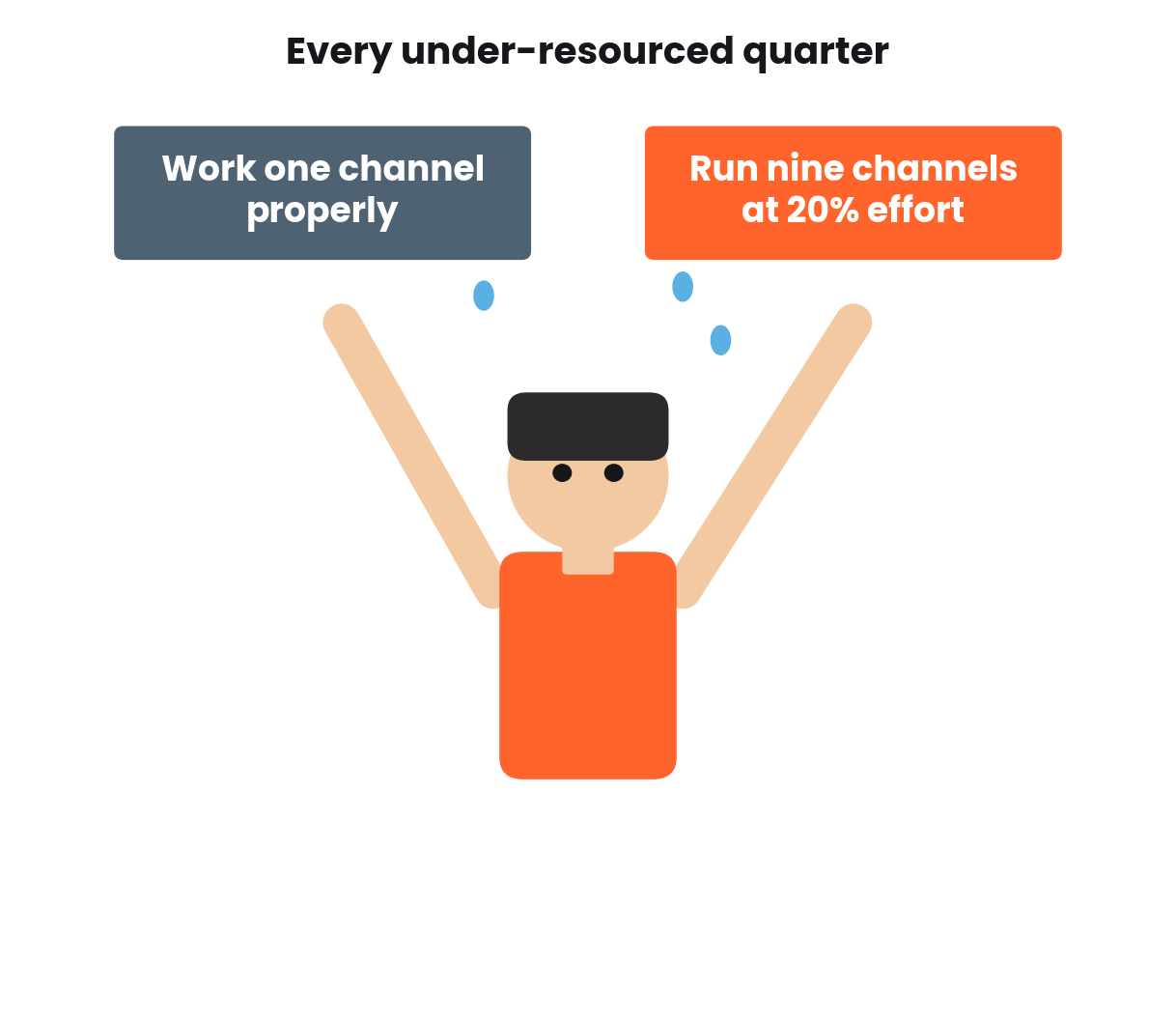
- The most expensive small-team mistake is running five channels at 20 percent effort instead of one at full effort.
What is a lean go to market strategy?
A lean go to market strategy is a plan that reaches a specific buyer through one repeatable motion, using a team small enough to fit in one conversation. It is defined by what it leaves out. Every decision in it removes work rather than adding it.
The word lean gets misread as cheap. It is not about spending less. It is about carrying less. A big team can afford to run six experiments at once because six people own one each. When you are three people, six experiments means nobody finishes anything and you spend the quarter reporting on activity.
Budget is rarely the real constraint anyway. Gartner found marketing budgets held at 7.7 percent of revenue in 2025, unchanged from the year before, and 59 percent of CMOs said that was not enough to execute their strategy. Those are companies mostly above a billion in revenue, with real departments. If they feel short, the constraint is not money. It is attention.
Attention is the thing you are actually rationing. So the plan has to be short enough to hold in your head while you are doing something else.
Why small teams get go to market wrong
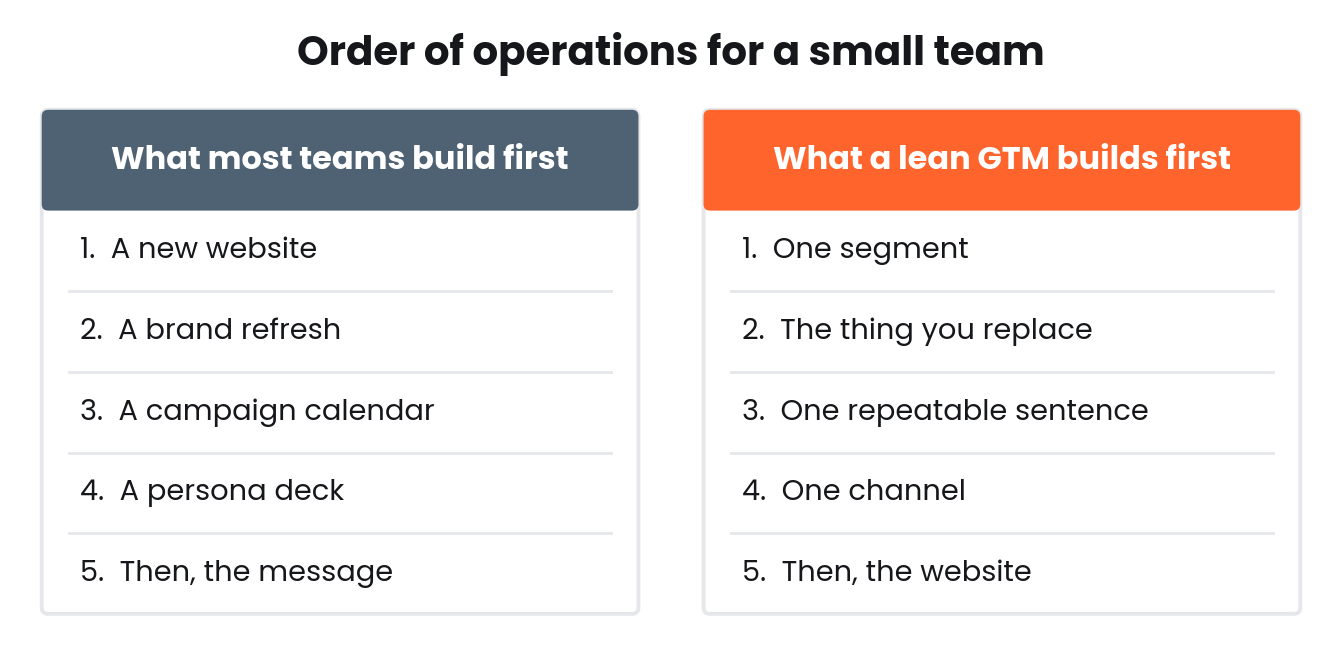
Small teams get GTM wrong by starting with output instead of with a decision. The website, the deck, the launch post. These are all downstream of a choice nobody made yet.
I have done this. Early on I rewrote a homepage three times in six weeks. The copy got better each time and the meetings did not. The problem was never the copy. Nobody had decided which of the four possible buyers we were for, so every version had to be true for all four, which meant it was specific for none.
The pattern shows up in the failure data too. CB Insights analysed 431 venture-backed companies that shut down and found 43 percent cited poor product-market fit. McKinsey has put the share of product launches that miss their business targets at more than half, and found no relationship between how much a company spent on a launch and whether it worked. More budget did not buy better outcomes. Clearer decisions did.
There are three specific traps I watch for.
The everything-at-once trap. Nine channels, each getting a fifth of the effort they need to produce a signal. At the end of the quarter you have nine inconclusive results and no idea which to kill.
The borrowed plan. A GTM plan lifted from a company with forty marketers and a category that already exists. It looks professional. It cannot be executed by three people, so it quietly becomes a document nobody opens.
The website-first reflex. The site feels like the responsible thing to fix because it is visible and it is yours. It is also the last thing that should change, because it is a summary of decisions you have not made yet.
The five decisions, in order
Here is the whole method. Five decisions. The order is the point.
Decision 1: Pick a segment narrow enough to feel uncomfortable
Choose one buyer, in one situation, with one trigger. If the choice does not make you slightly nervous, it is not narrow enough.
The nervousness is the signal. Narrowing feels like turning off revenue, and it is not, because you were not winning those deals anyway. What it actually does is make every later decision cheaper. You stop writing four versions of everything.
A useful test: can you name ten real companies that fit, and say why they would care this quarter? If you can only describe the segment in adjectives (mid-market, fast-growing, forward-thinking), you have written a wish, not a segment. I wrote a whole post on the difference between an ICP and a buyer persona, because most teams collapse the two and end up with neither.
Decision 2: Name what you replace, not the category you are in
Buyers do not evaluate you against a category. They evaluate you against what they are doing right now, which is usually a spreadsheet, an agency, an intern, or nothing.
Naming the alternative does two things. It tells you what your message has to beat, and it tells you where the buyer already is. If the alternative is a spreadsheet, your competition is inertia and your job is to make the cost of the spreadsheet visible. If the alternative is a funded competitor, your job is different and probably harder.
Write it as one line: “Today they do X. It costs them Y.” If you cannot fill in Y with something specific, you do not know the buyer well enough yet, and Decision 3 will produce something vague. That is the sequence working as designed. It tells you where you are thin.
Decision 3: Write one sentence a stranger can repeat
The sentence has to survive being said badly by someone who does not work for you. That is the whole bar.
This matters more than it used to. Gartner surveyed 632 B2B buyers and found buying groups of 5 to 16 people spread across as many as four functions, with 74 percent showing what they called unhealthy conflict during the decision. You will meet two or three of those people. The rest hear about you secondhand, from a colleague, in a hallway, badly paraphrased. Your sentence has to be the thing that survives that.
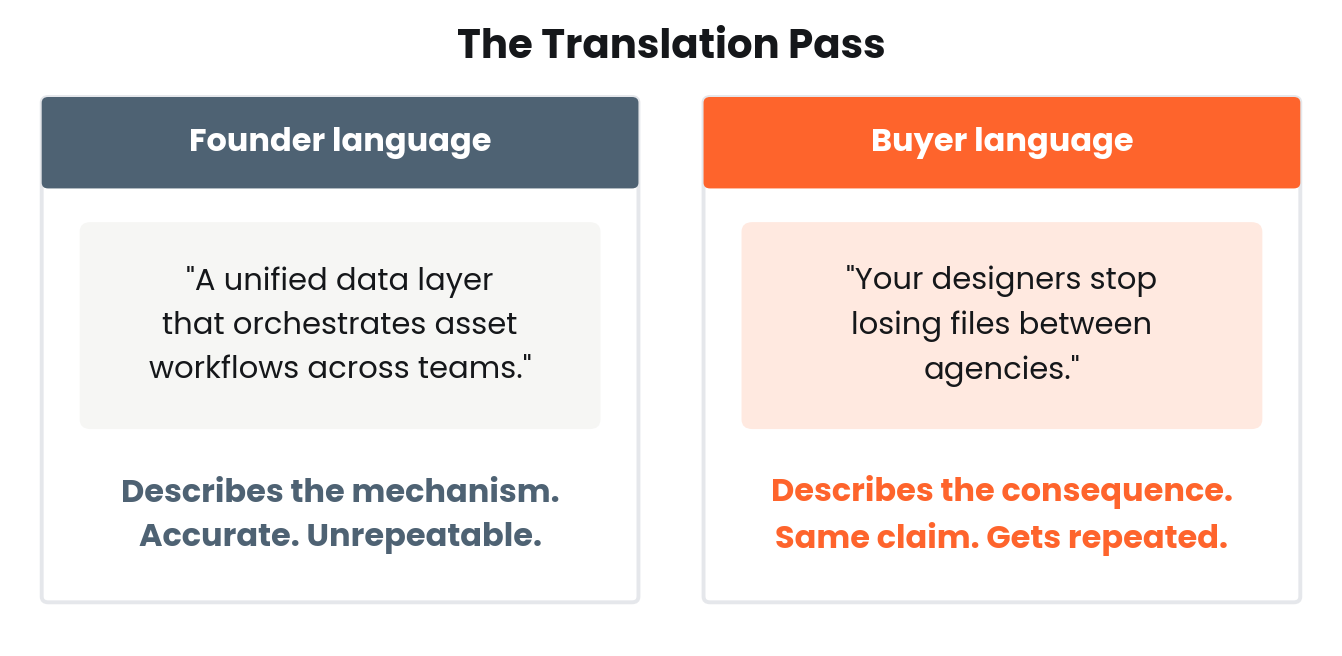
I call this step the Translation Pass. You put founder language and buyer language side by side and you keep only what the buyer would say out loud.
Founder version: “A unified data layer that orchestrates asset workflows across distributed teams.”
Buyer version: “Your designers stop losing files between agencies.”
The second one is not dumber. It is the same claim, aimed at the consequence rather than the mechanism. Founders describe how the thing works because that is what took them four years. Buyers care what stops hurting. My longer walkthrough of this sits in the product positioning playbook.
Decision 4: Pick one channel and work it for two quarters
One channel, one motion, long enough to get a real answer. For most early B2B, that is six months minimum before you know anything.
The reason for the patience is in the buying data. John Dawes at the Ehrenberg-Bass Institute put it plainly in 2021: up to 95 percent of business buyers are not in the market for a given product at any one time. He is careful to call it a heuristic rather than a precise measurement, and it still reframes the job. Almost everyone who sees your work this month is not buying this month.
Which means the goal is not to convert them. It is to be the name they already have when they do start looking. Bain and Google surveyed 1,208 people involved in business purchases and found 90 percent chose a vendor that was already on their shortlist on day one. Not discovered during evaluation. Already there.
That finding is good news for a small team, because it changes the question from “how do I reach everyone” to “how do I stay in front of a few hundred specific people, consistently, for a year.” A few hundred people is a job three humans can do. Reaching everyone is not.
Pick the channel where your specific buyer already spends attention, not the one with the best case studies. If you want the longer version of how I think about the demand side of this, it is in what is demand generation.
Decision 5: Decide now what proof you will have in ninety days
Before you start, write down the one number and the one artefact that will exist in ninety days. Then agree with the founder that this is what gets judged.
The number is not pipeline. Ninety days is usually too short for pipeline in B2B, and promising it is how good marketers get fired for arithmetic. Pick something honest and leading: qualified conversations from the target segment, or reply rate from a named list, or the number of sales calls where the buyer used your sentence back at you.
The artefact matters as much. A message-tested one-pager the sales team actually opens. A recorded demo that closes without you. A short list of ten accounts that now know your name. Artefacts survive a bad quarter. Dashboards do not.
Writing this down before you start is the most useful five minutes in the whole plan. It ends the argument you would otherwise have in month four.
The first thirty days: what I do before writing any copy
I do not write anything in month one. I listen, and I write down words.
This is the part people skip because it does not look like work. Here is what it actually is.
I sit in on eight to twelve sales calls. Not summaries, not notes, the actual calls. I am listening for the moment the buyer relaxes, and the moment they go quiet.
I read every lost-deal note from the last year. Lost deals tell you the truth that won deals hide, because nobody performs gratitude in a lost deal.
I talk to the two people who have been there longest and are not in leadership. Support, implementation, the first salesperson. They know which promise breaks in month three.
I collect a list of exact buyer phrases. Not themes. Phrases. The words in the order they said them.
Then I write. And the writing takes about a day, because by then it is mostly transcription.
The temptation with a small team is to skip this because thirty days feels expensive when you are the only marketer. It is the opposite. Thirty days of listening is what stops you spending the next six months on copy that has to be rewritten.
A worked example
Here is one that went badly first, which is why I trust it.
An industrial product, genuinely complicated, sold into plants. The homepage said it improved operational visibility. Every competitor said something close enough that you could swap the logos. Demos were booking fine and closing badly.
We ran the five decisions.
Segment. We had been selling to “manufacturers.” We narrowed to plants running a specific kind of shift handover, with a maintenance lead who had been burned by a failed rollout before. That felt like cutting off most of the market. It cut off roughly none of the revenue, because we were not winning the rest.
Alternative. Not a competitor. A whiteboard and a WhatsApp group. Once we wrote that down, the message got easier immediately, because we stopped arguing about features and started arguing about what happens when the person who knows everything goes on holiday.
Sentence. “Nothing gets lost when the shift changes.” Nine words. A maintenance lead could say it to a plant manager without a slide.
Channel. One. We stopped everything except showing up where those maintenance leads already talked to each other, and doing it every week for two quarters. It was slow for four months and then it was not.
Proof. We agreed upfront on one number: how many first calls started with the buyer describing their own shift handover problem before we asked. That number is unglamorous and it is impossible to fake.
The lesson I took from it: the sentence was not a writing problem. It was a decision problem wearing a writing costume. Nine words took a day. The month of listening that made those nine words possible is the actual work.
What I skip when the team is three people
Some of these are permanent skips. Some are just not yet. Knowing which is which is most of the job.
A rebrand. Almost never the constraint. A rebrand is what teams do when they know something is wrong with the message and would rather solve it with a colour palette.
A full website rebuild. Change five pages, not fifty. If the sentence is wrong, a beautiful site just delivers the wrong sentence faster.
Lead scoring. With twelve customers you do not have enough data to score anything. You have enough to read every lead yourself, which is better.
Attribution software. HubSpot’s 2026 State of Marketing report, based on more than 1,500 marketers, found measuring ROI is still the number one challenge, ahead of lead generation. Teams with real budgets have not solved this. You will not solve it with a tool and no analyst.
A persona deck. Unless someone outside marketing asked for it, it is a document that exists to prove you did research. Put the research in the sentence instead.
Anything with the word programme in it. If it needs a programme it needs a person, and you do not have a spare one.
What I do not skip: talking to buyers, and writing things down where sales can find them. Those two survive every budget cut I have ever been on the wrong side of.
How I measure it when attribution is a spreadsheet
Track three things, and be honest that they are directional rather than precise.
One leading number, agreed in advance. The one from Decision 5. It does not change mid-quarter, even when it looks bad in month two. Especially then.
Language drift. Are buyers using your words back at you, unprompted? I count this manually from call recordings. It is the earliest signal that positioning has landed, and it moves months before pipeline does.
Self-reported source. One open field on the form: “How did you hear about us?” It is unreliable, it is biased, and it is still better than a multi-touch model built on a hundred data points a month. With small numbers, ask people.
Then say out loud, in the meeting, that these are estimates. Marketers lose credibility by defending precision they do not have. You keep more of it by naming the uncertainty first, then acting anyway. The other version of this conversation is the one I wrote about in why marketing and sales keep blaming each other.
Conclusion
A lean go to market strategy is not the version you run until you can afford the real one. Constraint is not a temporary state you graduate out of, and the teams I have seen grow did not get better when they got bigger. They got better when they got clearer, and then they got bigger.
Five decisions. In order. Written on one page.
If you only take one thing: narrow the segment before you write anything. Everything downstream gets cheaper, and you will notice within two weeks.
If you want the longer version aimed at early stage companies specifically, it is in my go to market playbook.
Frequently Asked Questions
What is a lean go to market strategy?
A lean go to market strategy is a plan that reaches one specific buyer through one repeatable motion, executed by a small team. It is built as a sequence of five decisions: the segment, the alternative you replace, the one sentence a stranger can repeat, the single channel, and the proof you will have in ninety days. It is defined by what it excludes rather than what it includes.
How small a team can run a go to market strategy?
One person can run a lean GTM strategy, and many do. The constraint is not headcount, it is the number of channels and segments you commit to. A single marketer working one segment through one channel will usually outperform three marketers spread across four segments and six channels, because only the first setup produces a clear signal within a quarter.
What should a small marketing team build first?
Start with the buyer decision, not the asset. Pick the segment, name the alternative you replace, and write one sentence a stranger could repeat. Only then touch the website, the deck, or the campaign. Most small teams build the website first, which forces them to summarise decisions they have not made yet.
How long before a lean go to market strategy shows results?
Plan for two quarters before a channel gives you a real answer, and ninety days before you have any honest signal. Up to 95 percent of business buyers are not in the market at any given moment, according to John Dawes at the Ehrenberg-Bass Institute, so most of the people you reach this month are not buying this month. Judge the first ninety days on leading indicators like qualified conversations and language drift, not on pipeline.
Do I need a big budget for a go to market strategy?
No. Gartner’s 2025 CMO Spend Survey found marketing budgets flat at 7.7 percent of company revenue, and 59 percent of those CMOs still said it was not enough. McKinsey found no correlation between launch spend and launch success. The binding constraint on a small team is attention and sequence, not money.
What is the most common go to market mistake small teams make?
Running too many channels at once. Five channels at 20 percent effort each produce five inconclusive results and no basis for a decision. One channel worked properly for two quarters produces an answer you can act on, which is the only thing a small team can afford to buy.
Should I hire an agency or build in-house with a small team?
Build the decisions in-house and buy execution outside. An agency cannot make your segment or your sentence for you, because those come from listening to your buyers and your lost deals. Once the sentence exists and holds up in sales calls, outsourcing production such as design, video, or paid media is reasonable and often cheaper than hiring.
About the author
I am Rosi Rusmiati, a B2B marketer who builds marketing functions from nothing, usually at companies whose product nobody can explain yet. I have done it three times, in US and European markets, in a language that is not my first. I write about making complicated things clear. Usually a product. Sometimes a life.
-
Demand Generation Isn't About Getting More Leads
-
Why Marketing and Sales Keep Blaming Each Other.
-
The ICP vs. Buyer Persona Mistake I See All the Time.
-
Product Led or Sales Led? Here's How I Think About It.
-
What I Learned About Product Marketing After Working in B2B SaaS.
Recent posts:
Author

Rosi
Head of Marketing
Go-To-Market • Content • Growth