Learn why the marketing vs sales blame game keeps repeating, what actually causes it, and the four fixes that work better than another alignment meeting.
Table of Contents
Learn what really drives the marketing vs sales blame game, why both sides are telling the truth, and how to stop the loop without another alignment meeting.
Introduction
Marketing and sales blame each other because they are measured on two different things, and the handoff between them is the only place where that difference becomes visible. Marketing is scored on leads. Sales is scored on closed revenue. When the number at the end is bad, the handoff is the seam everyone points at.
That is the whole answer. Everything else in this post is detail.
Here is what makes it exhausting. Both sides are usually right. Sales really is getting leads that will never buy. Marketing really is watching good leads sit untouched in the CRM. Neither team is lying, and neither team is lazy. They are describing two halves of the same broken system, and the argument feels personal because nobody can see the other half.
I have sat in these meetings. They follow the same script every time, and the script never ends with a fix. It ends with a new dashboard.
Key Takeaways
- The conflict is structural, not personal. Harvard Business Review named the two roots back in 2006: money (both teams pull from one budget) and culture (the two jobs attract different people). Twenty years later, nothing about that has changed.
- Leads are a terrible unit of measurement. Forrester’s benchmarks show lead-centric processes turn an inquiry into a closed deal less than 1 percent of the time. A process that fails 99 percent of the time will always look like somebody’s fault.
- Nobody sells to a lead. Over 80 percent of B2B purchase decisions involve a buying group of more than three people, according to the same Forrester research. Marketing sends one name. Sales needs four.
- Marketing is judged on a quarter. Buying takes years. About 95 percent of business buyers are not in the market at any given moment, per Professor John Dawes at the Ehrenberg-Bass Institute.
- The buyer left the funnel. Gartner found 67 percent of B2B buyers now prefer a rep-free experience. The handoff both teams are fighting about is not where the deal is actually decided.
- You fix it with definitions and shared numbers, not goodwill. Alignment workshops fail. A written definition of a qualified account, one shared revenue number, and a monthly deal review do not.
What the Blame Game Actually Sounds Like
You already know the lines. Writing them down helps, because seeing both scripts next to each other shows how neatly they interlock.
Sales says the leads are junk. They say marketing has never sat on a call with a real buyer. They say the last campaign brought in 400 students and consultants. They say the pricing page promises something the product does not do, and now they have to walk it back on the demo.
Marketing says sales never follows up. They say they handed over 200 leads and 60 of them were never touched. They say sales only wants introductions to people who already have budget approved and a signature ready. They say every piece of content they build gets ignored, and then somebody asks for a one-pager the night before a big meeting.
Both lists are accurate. That is the uncomfortable part.
Why the Fight Is Structural, Not Personal
In 2006, Philip Kotler, Neil Rackham and Suj Krishnaswamy published a piece in Harvard Business Review called “Ending the War Between Sales and Marketing.” They interviewed CMOs and sales VPs across a lot of industries and found the same two roots everywhere.
The money problem
There is one budget. It gets split between the two teams, and the split is almost never even. Every euro that goes into a brand campaign is a euro that did not go into sales headcount, and the person who lost the argument remembers.
This is why budget season makes the blame worse. Suddenly both teams need to prove the other one is wasteful.
The culture problem
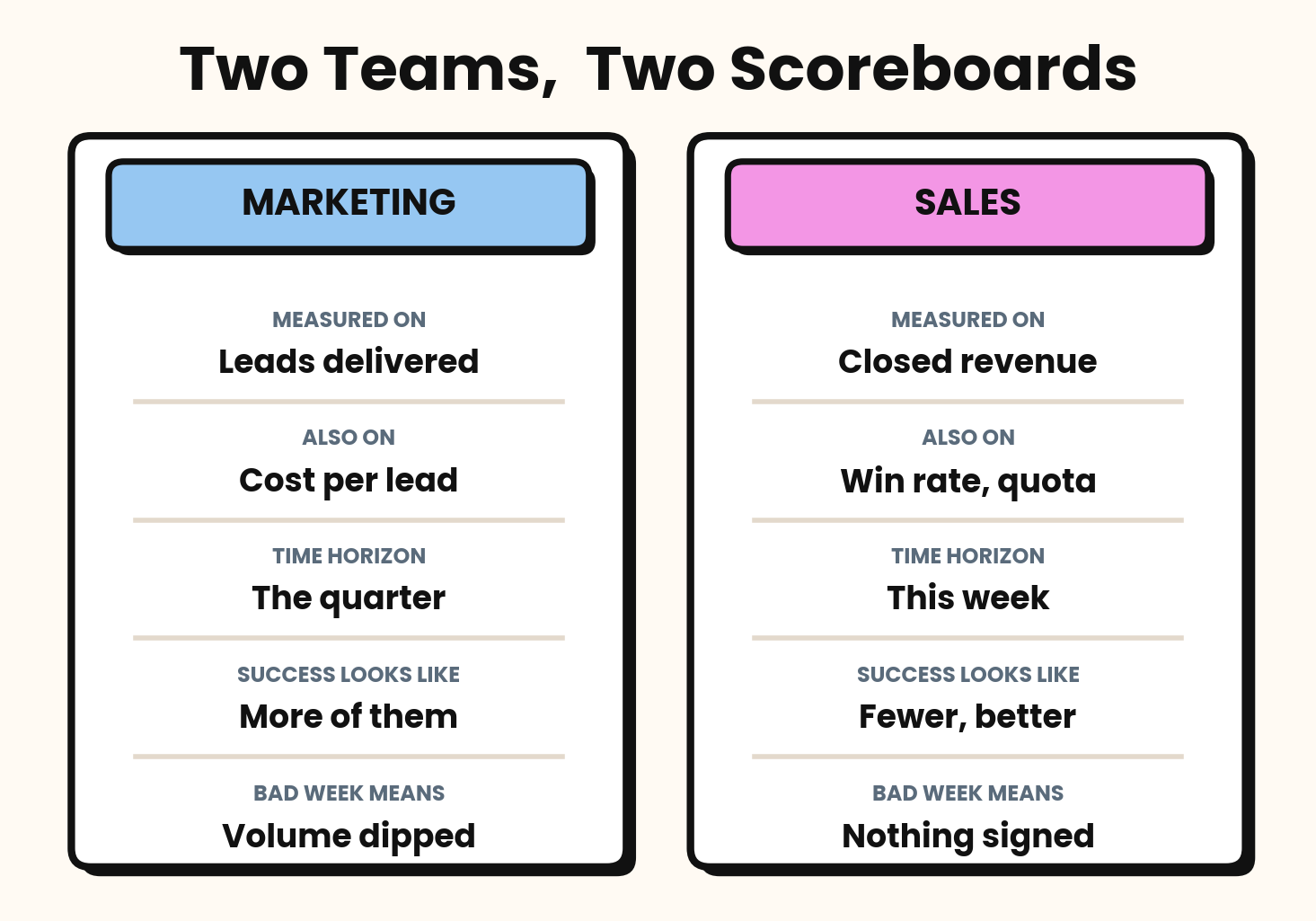
The two jobs attract different people, and reward opposite instincts.
Sales lives in weeks. A rep knows on Friday whether the week worked. They are close to individual buyers, they trust what a specific person told them on a call, and they get paid on things that closed.
Marketing lives in quarters and patterns. A marketer cares about what is true across 500 accounts, not what one prospect said on Tuesday. Their best work often pays off after the quarter it was funded in.
Neither view is wrong. They just produce different answers to “what should we do next week,” and each side reads the other’s answer as carelessness.
Reason 1: You Are Measuring Two Different Things
This is the mechanical cause, and it survives every reorg.
Marketing’s targets are usually volume targets. Leads, cost per lead, pipeline sourced, traffic, sign-ups. Sales targets are revenue targets. Closed won, average deal size, win rate, quota attainment.
Volume goes up when you lower the bar. Revenue goes up when you raise it. So the two teams are being paid to push the same dial in opposite directions, and then asked why they do not get along.
The Marketing Week State of B2B Marketing survey of 450 brand marketers in 2025 put a number on the pressure. Almost 38 percent said their department is pushed to deliver marketing qualified leads regardless of quality. Just over a quarter said delivering leads is their only success metric. More than half said senior leadership does not see what marketing can do beyond lead generation.
Read that again. A third of marketing teams are being told, in effect, to bring quantity and worry about quality later. Then they get blamed for bringing quantity.
Reason 2: Nobody Agreed on What a Lead Is
Ask five people in your company to define a qualified lead. You will get five answers, and at least two of them will be “someone who downloaded something.”
That is not a joke, it is the actual failure mode. Forrester’s Terry Flaherty wrote in 2022 that lead-centric processes convert an inquiry into a closed deal less than 1 percent of the time. His phrasing is worth stealing: the process fails more than 99 percent of the time. He also points out that lead scoring thresholds are usually built on guesses rather than any real analysis of who tends to buy.
So the MQL, the object that both teams fight over, is a number somebody made up. Marketing hits it. Sales does not believe it. Both are behaving rationally.
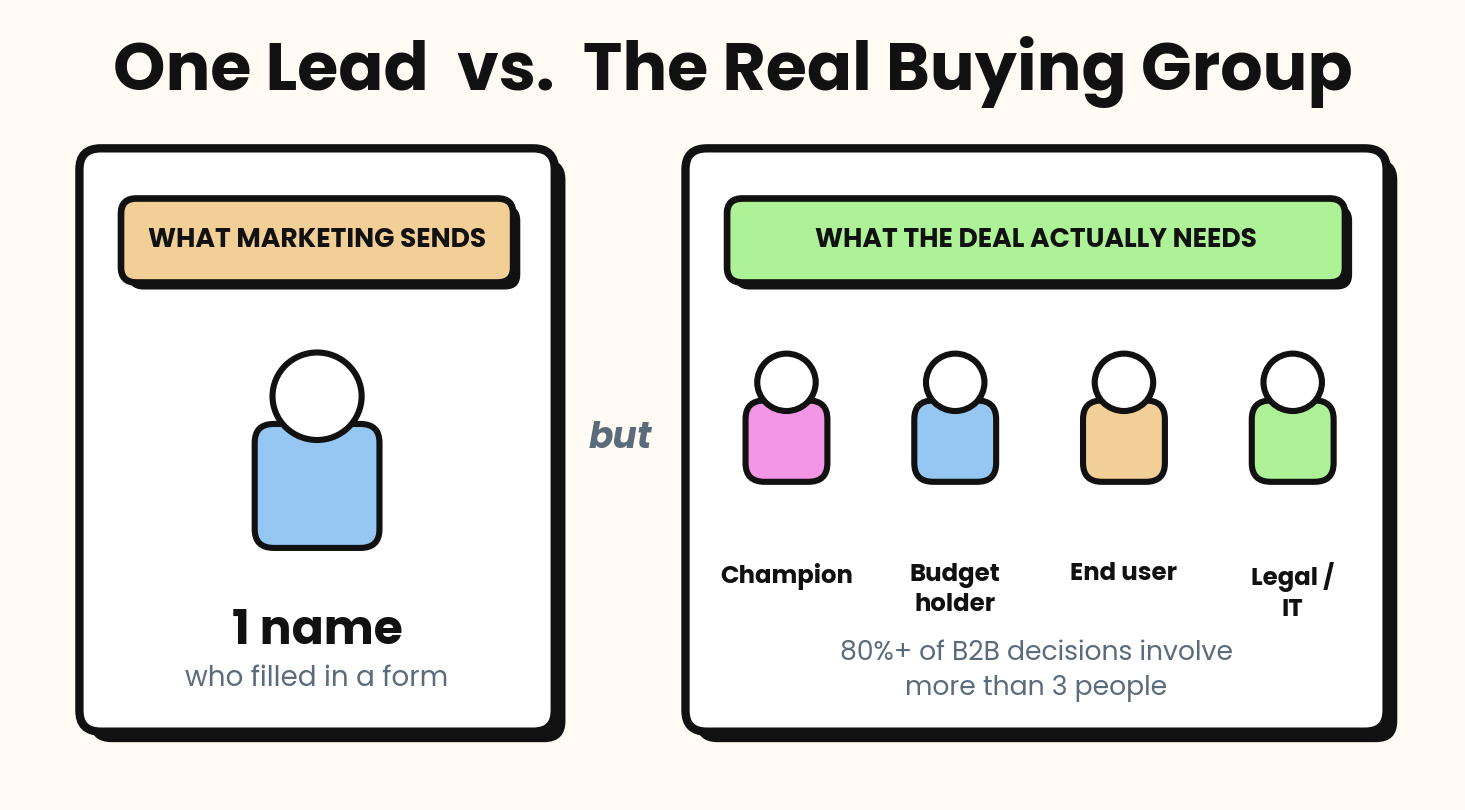
There is a second problem hiding inside the first. The same Forrester research found that over 80 percent of B2B purchase decisions involve a buying group of more than three people. A lead is one person. A deal needs a group. Marketing is optimised to produce individuals, and sales is trying to assemble committees.
If you have never mapped who is actually in that room, my post on ICP vs buyer persona walks through it.
Reason 3: The Buyer Stopped Using Your Funnel
Both teams are arguing over a handoff the buyer no longer walks through.
Gartner surveyed 646 B2B buyers between August and September 2025 and found 67 percent prefer a rep-free experience. Forty-five percent used AI during a recent purchase. Buyers are doing the work themselves, in places neither team can see, and often before anyone fills in a form.
So the CRM shows you a fight over 200 leads while the real decision is happening in a Slack thread, a peer group, and three tabs of comparison research.
Here is the part that should change the argument. Gartner also found buyers are 1.8 times more likely to complete a high-quality deal when they use a supplier’s digital tools together with a sales rep, rather than doing it alone. The buyer does not want to choose between your content and your rep. They want both, at the same time. Which is exactly the thing a blame culture makes impossible.
Reason 4: Marketing Is Judged on a Quarter, Buying Takes Years
Professor John Dawes at the Ehrenberg-Bass Institute published the 95:5 rule in 2021. The idea is simple. Companies replace big service providers roughly every five years, so at any given moment only about 5 percent of your market is actually buying. The other 95 percent are not ignoring you. They are just not shopping.
Dawes is careful to say it is a rough heuristic, not a precise law. It still explains a lot of arguments.
Work that reaches the 95 percent pays off in a year or two. Work that reaches the 5 percent pays off this quarter. Marketing’s most valuable work has the longest lag, and lag looks identical to failure on a quarterly dashboard. So marketing gets pulled toward the 5 percent, produces more short-term leads, and the quality complaint gets louder. I wrote more about that split in what is demand generation.
Reason 5: Content Gets Made in a Vacuum
Back in 2013, SiriusDecisions found that 60 to 70 percent of the content B2B marketing teams produce sits unused. More than a decade later, ask any sales team what they actually send buyers and you will hear about three assets and one deck somebody rebuilt themselves.
Marketing sees this as sales ignoring their work. Sales sees it as marketing making things nobody asked for. Usually what happened is that nobody asked the reps what objection they hit on the third call.
That gap is not a talent problem. It is a calendar problem. Marketing planned the content in a quarterly planning session, and sales learned what buyers actually push back on last Tuesday.
The Blame Loop, With Numbers
Here is the worked example I use when a team tells me they have a lead quality problem. Run your own numbers through it, because the shape matters more than the exact figures.
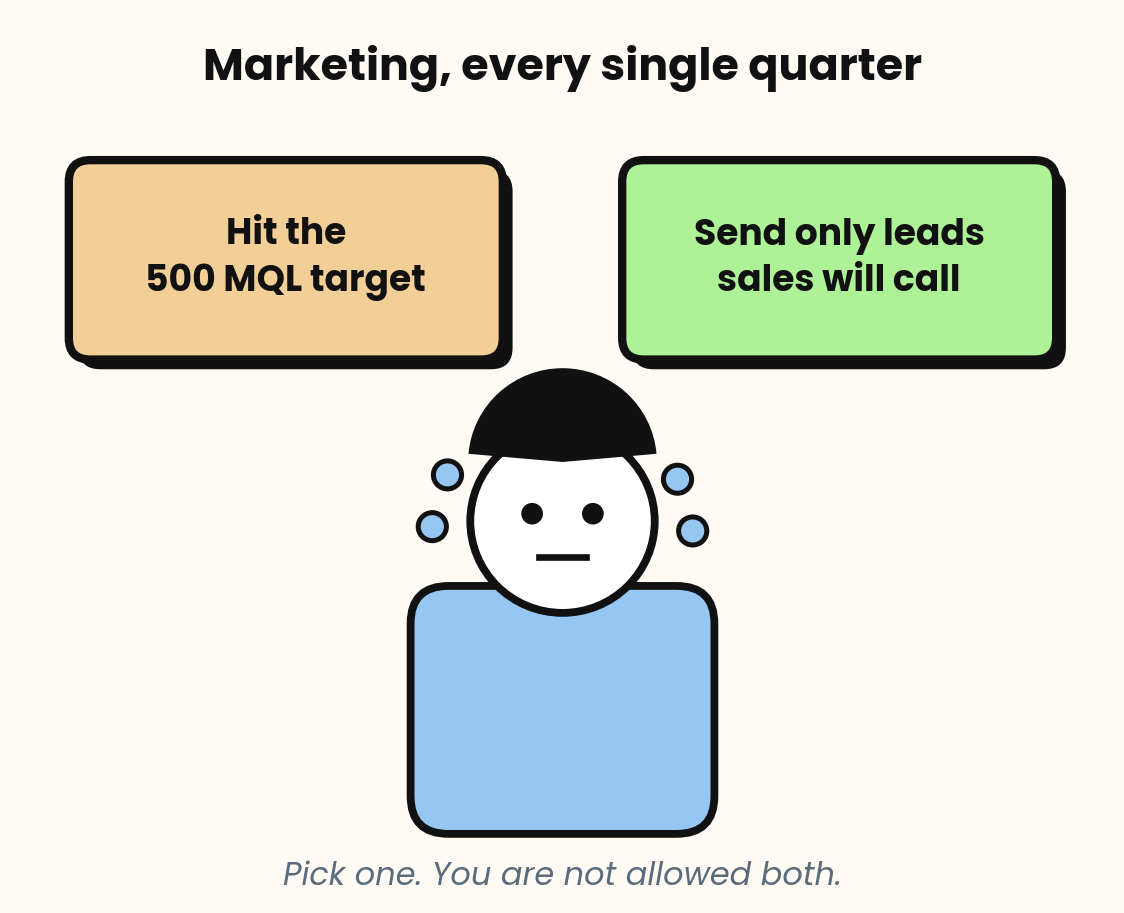
Say marketing is asked for 500 MQLs this quarter. They hit it. Of those 500:
- 150 are students, competitors, consultants, or people who wanted the template.
- 250 are real companies, but only one person from each, and none of them have a live project.
- 80 are real companies with a live project, but the person who filled the form has no budget.
- 20 are actual opportunities.
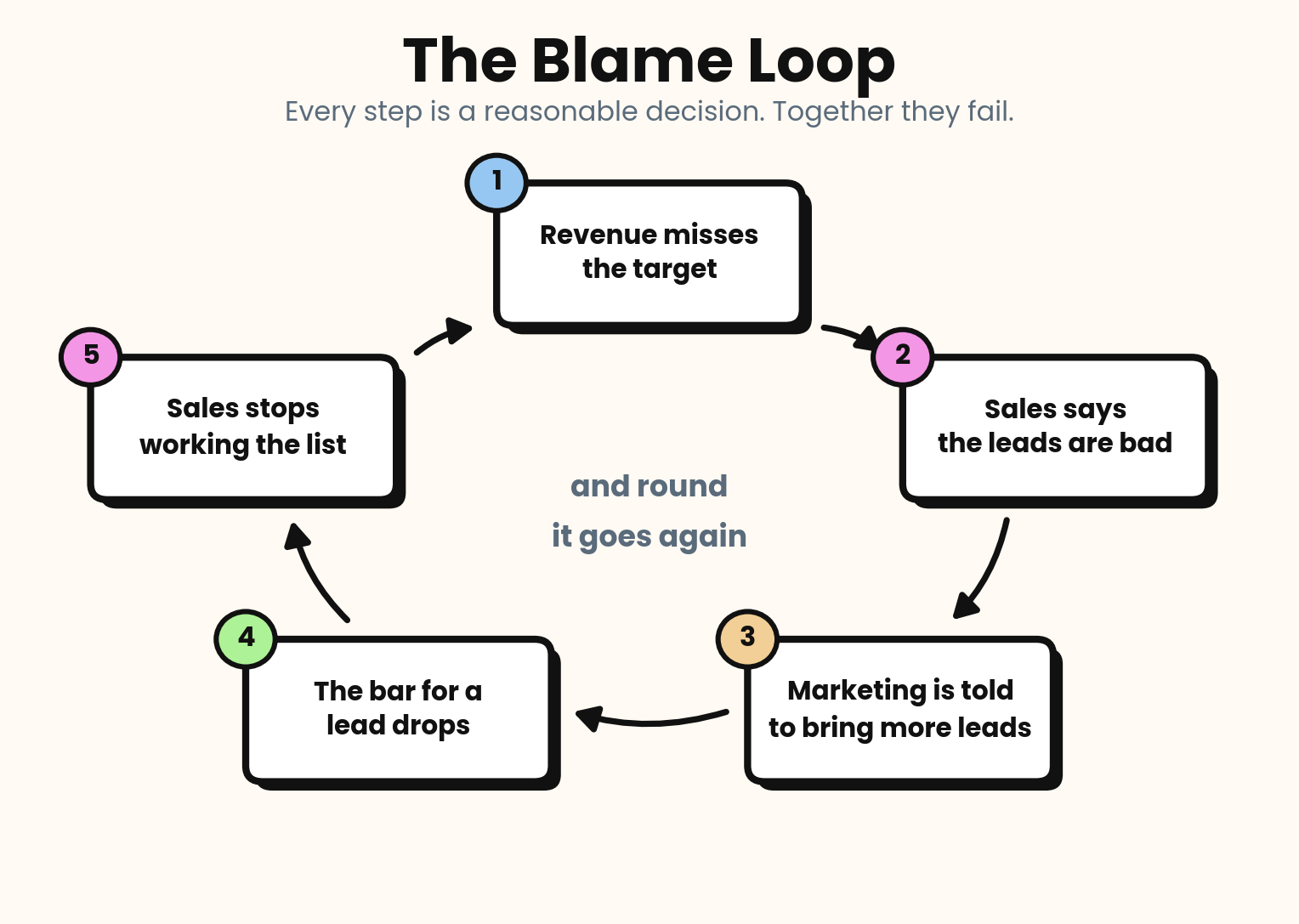
Sales works the list top-down. The first thirty calls go badly, because the list is sorted by download date and not by fit. By call thirty-five, the rep has decided the list is junk and starts prioritising their own outbound instead. Ten of those 20 real opportunities never get a second attempt.
Now watch what each team reports at the end of the quarter.
Marketing reports 500 MQLs delivered, target hit, cost per lead down 12 percent. All true.
Sales reports 10 closed deals against a target of 20, and says lead quality was the problem. Also true.
Leadership hears two credible stories that contradict each other, so they ask for more leads next quarter. The bar drops again. That is the loop.
The thing to notice is that no individual behaved badly. The rep who deprioritised the list was making a sensible call with the information they had. The marketer who optimised for volume was doing the job they were given. You cannot fix this with a better attitude, because attitude is not what is generating the outcome.
How to Actually End It
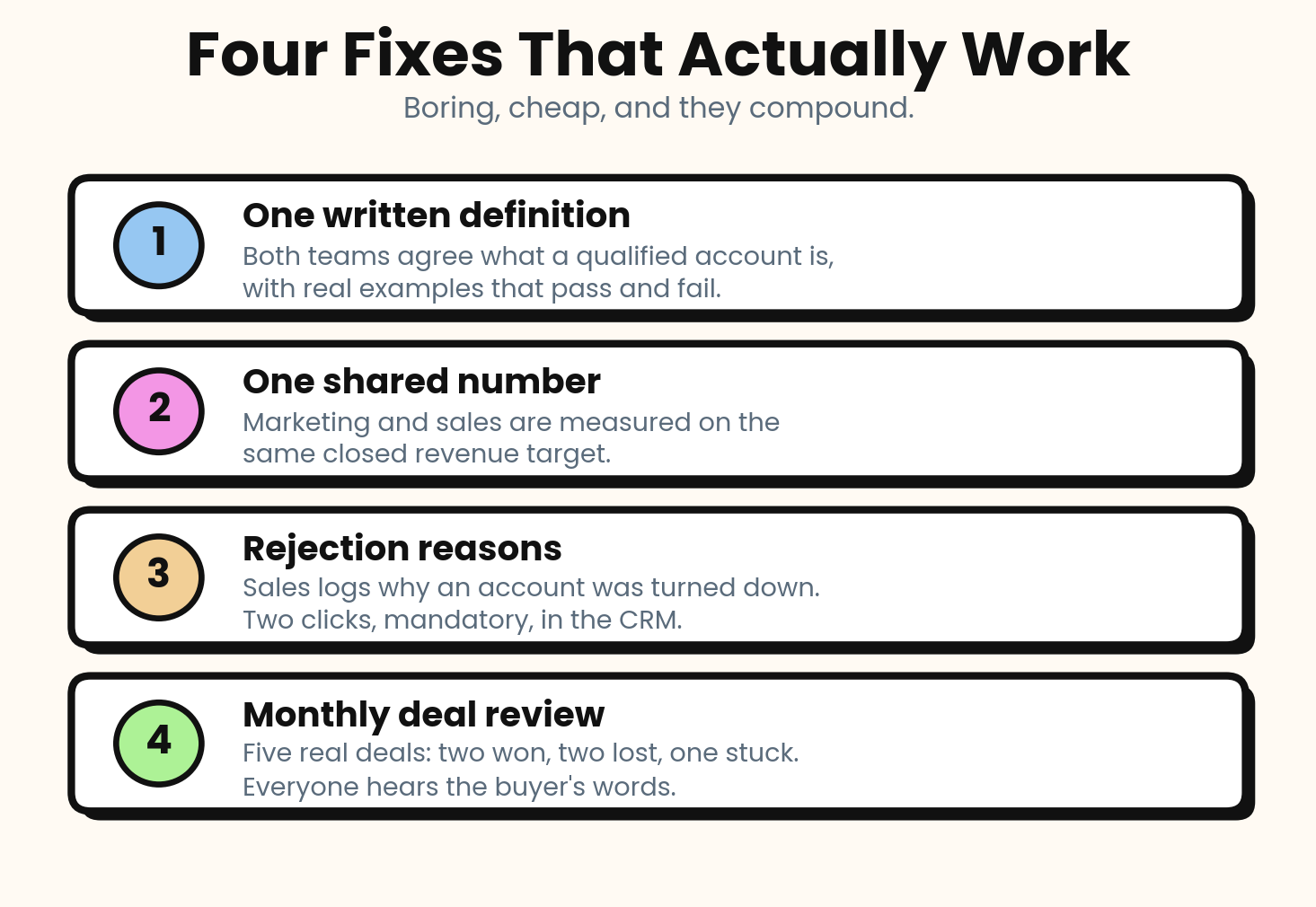
Alignment offsites do not work, because the problem is not that people dislike each other. Four things do work, and they are all boring.
1. Write down what qualifies, in one sentence, together
Not a lead score. A written definition of an account worth pursuing, agreed by both teams, with examples of accounts that pass and accounts that fail. If sales cannot name three accounts that should have passed but did not, the definition is not specific enough yet.
Then hold it. The definition only works if marketing is allowed to deliver fewer things that meet it. If you keep the volume target and add a quality definition on top, you have changed nothing.
2. Give both teams the same number
One revenue number, owned by both. Marketing can keep its own operating metrics for diagnosis, but the number on the wall, the one leadership asks about, has to be shared. When marketing’s bonus depends on closed revenue, the argument about lead quality resolves itself in about a month.
3. Make the handoff a two-way street
Marketing owes sales a definition of a good account. Sales owes marketing a reason when they reject one. Two clicks in the CRM, mandatory, with a short list of reasons: wrong company size, no project, wrong role, already a customer, bad timing.
That rejection data is the most useful marketing input you will ever get, and almost nobody collects it. Within a quarter you will know exactly which campaign is producing the junk, and it is rarely the one everyone assumed.
4. Put them in the same room once a month, looking at real deals
Not a status update. A review of five deals: two won, two lost, one stuck. Everyone hears the actual words the buyer used. Marketing finds out which objection keeps killing deals on the third call. Sales finds out which content the buyer read before they ever booked.
I would rather have this one meeting than any dashboard. It works because it replaces opinions about each other with evidence about the buyer.
If the underlying problem is that neither team agrees on who you are selling to in the first place, start with your go-to-market plan instead. No handoff process survives a fuzzy target.
What This Looks Like When It Is Working
You will know the loop is broken when the language changes. People stop saying “your leads” and “your follow-up” and start saying “this account.” The monthly review stops being defensive. Somebody in marketing quotes a buyer objection word for word without having to ask what it was.
It will not feel like a big win. It feels like fewer arguments and a slightly more boring meeting, which is what fixed things usually feel like.
Conclusion
Marketing and sales keep blaming each other because the system pays them to want different things, and the handoff is the only place that difference is visible. Both sides have real evidence. Both sides are describing half of the same problem. Everything else, the personality clashes, the sniping in Slack, the offsite that changed nothing, is downstream of that.
So stop trying to fix the relationship. Fix the definition, the number, and the feedback loop, and the relationship follows.
One question to take into your next meeting. If your marketing team’s bonus depended entirely on closed revenue, would they still send you those 500 leads?
If the answer is no, you do not have a people problem. You have a scoreboard problem.
Frequently Asked Questions
Why do sales and marketing blame each other?
Sales and marketing blame each other because they are measured on different outcomes and the handoff between them is where the mismatch becomes visible. Marketing is usually scored on lead volume and cost per lead, while sales is scored on closed revenue. When revenue misses, each team points at the part of the process it cannot see.
What causes sales and marketing misalignment?
The two classic causes, identified by Kotler, Rackham and Krishnaswamy in Harvard Business Review in 2006, are economic and cultural. Economically, both teams draw from one budget, so any split creates a loser. Culturally, the two roles attract different people who work on different time horizons: sales thinks in weeks and individual buyers, marketing thinks in quarters and patterns.
Is bad lead quality marketing’s fault or sales’ fault?
Usually neither. It is a definition problem. If nobody has written down what a qualified account looks like, marketing optimises for the metric it was given (volume) and sales rejects anything that does not look ready to buy. Forrester found lead-centric processes convert inquiries to closed deals less than 1 percent of the time, which means the process itself is the main source of the failure.
What is an SLA between sales and marketing?
A service level agreement between sales and marketing is a written commitment covering what each team owes the other. Typically it defines what counts as a qualified account, how many marketing will deliver, how fast sales will follow up, and how sales will record a reason when they reject one. The rejection reason is the part most teams skip, and it is the part that actually improves lead quality.
How do you fix sales and marketing alignment?
Start with four things: one written definition of a qualified account agreed by both teams, one shared revenue number that both teams are measured on, mandatory rejection reasons logged in the CRM, and a monthly review of real won and lost deals. Skip the alignment workshop. The problem is incentives and information, not goodwill.
Should we get rid of MQLs entirely?
Not necessarily, but you should stop treating the MQL as the thing both teams are judged on. Forrester recommends moving from lead-centric to opportunity-centric processes, because over 80 percent of B2B purchase decisions involve a buying group of more than three people. Keep the MQL as an internal diagnostic if it helps, and put the shared target on pipeline and revenue instead.
How long does it take to stop the blame game?
Expect one quarter to see behaviour change and two or three quarters for the numbers to follow. The definition and the shared number can be agreed in a week. What takes time is building enough rejection data and enough deal reviews that both teams trust the picture, which is roughly one full sales cycle.
-
Demand Generation Isn't About Getting More Leads
-
How I Build a GTM Strategy Without a Huge Marketing Team
-
The ICP vs. Buyer Persona Mistake I See All the Time.
-
Product Led or Sales Led? Here's How I Think About It.
-
What I Learned About Product Marketing After Working in B2B SaaS.
Recent posts:
Author

Rosi
Head of Marketing
Go-To-Market • Content • Growth