You cannot run product-led growth on a product nobody can explain. What to fix first
Table of Contents
The real question is not which model is better. It is which one fits what you sell, who buys it, and how fast they feel the value.
Introduction
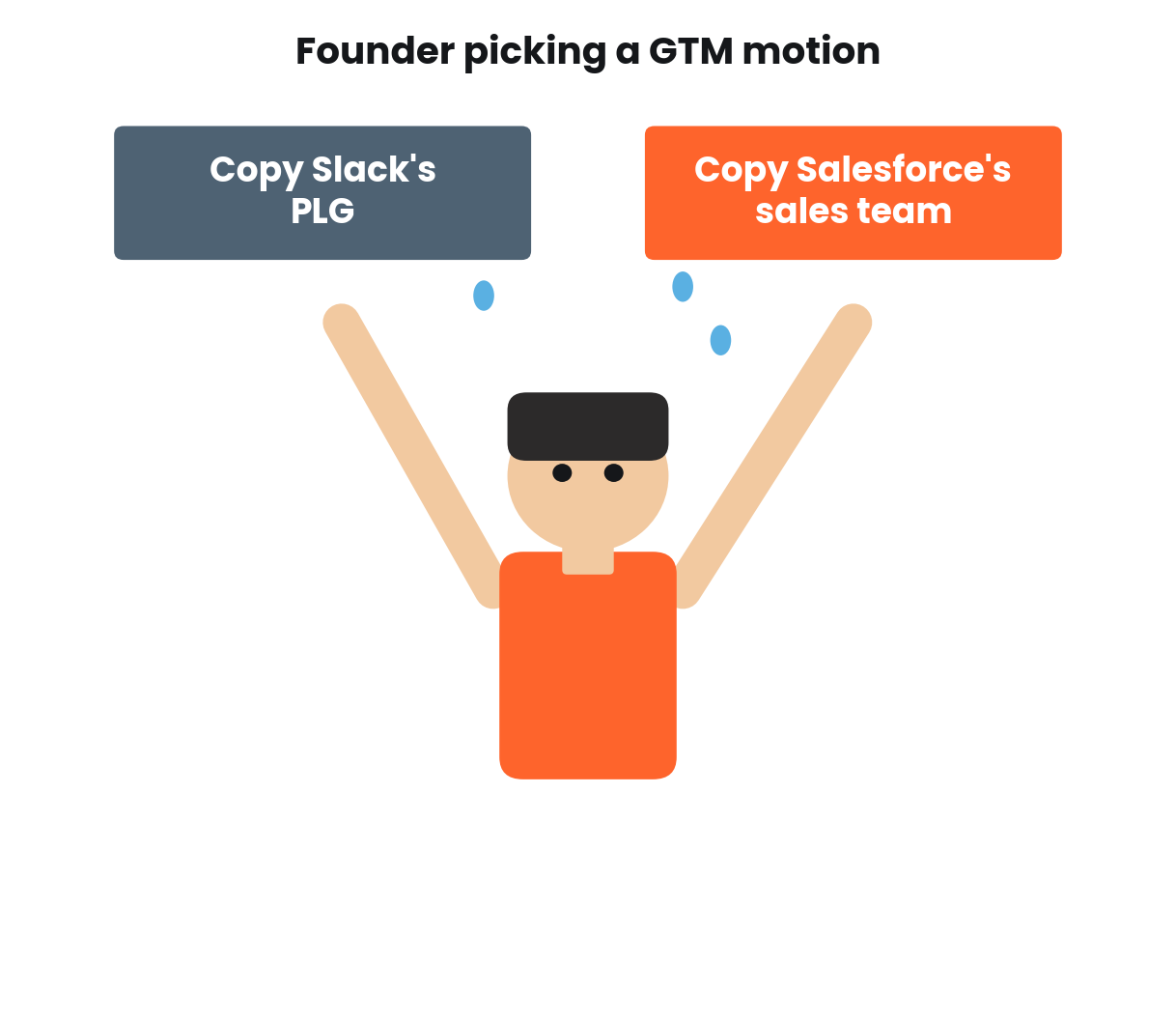
You watched Slack grow to millions of users without much of a sales team and thought, we should do that. Then you looked at Salesforce, with its army of reps closing giant deals, and thought, or maybe that. So which one is right for you?
Here is the short answer. Product-led growth (PLG) lets the product do the selling. People sign up, try it, and pay, often without ever talking to a human. Sales-led growth puts a salesperson at the center: reps find buyers, run demos, and close the deal. Neither one is better. The right choice depends on your price, your buyer, and how quickly someone feels the value.
Most articles on this topic stop at the definition. This one is about the decision. I will give you five questions that tell you which motion fits, a worked example with the same product going two different ways, and the case for running both at once.
Key Takeaways
- Product-led growth means the product drives signups, usage, and revenue with little or no sales contact. Sales-led growth puts reps at the center of every deal.
- The choice is not about which model is trendier. It comes down to price, who decides, product friction, and time-to-value.
- Product-led companies were 2x more likely to grow revenue 100% year over year than sales-led peers, according to OpenView’s 2022 benchmarks.
- PLG-focused software firms are nearly 3x more likely to gain market share, Bain found.
- A credit-card-sized price and an end user who can start alone point to PLG. A six-figure contract and a buying committee point to sales.
- Most companies end up running both. Product-led sales layers reps onto self-serve once accounts show real usage.
What Product-Led and Sales-Led Growth Actually Mean
Product-led growth is a go-to-market motion where the product is the main way you get, keep, and grow customers. Think free trials, freemium plans, and self-serve checkout. Slack, Zoom, Calendly, and Figma all grew this way. People found the product, used it, and pulled out a credit card, sometimes before anyone from sales knew they existed.
Sales-led growth flips that. A salesperson is the main channel. Reps generate pipeline, run demos, write proposals, and negotiate contracts. Salesforce, Workday, and most enterprise software you have heard of sell this way. The buyer rarely touches the product before signing.
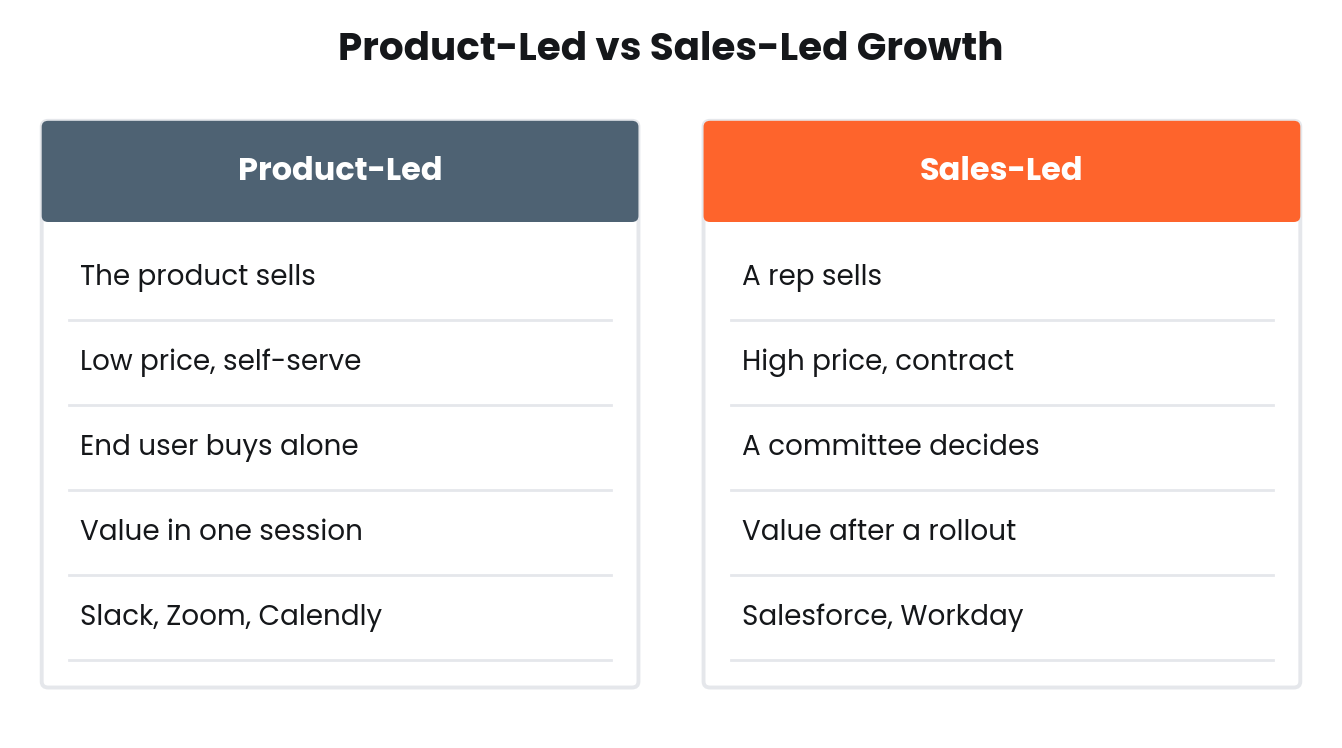
One thing worth naming: this is about the primary motion, not a religion. A product-led company still has salespeople. A sales-led company still has a “start free” button somewhere. The question is which one carries the weight.
The Real Question Is Not Which One Wins
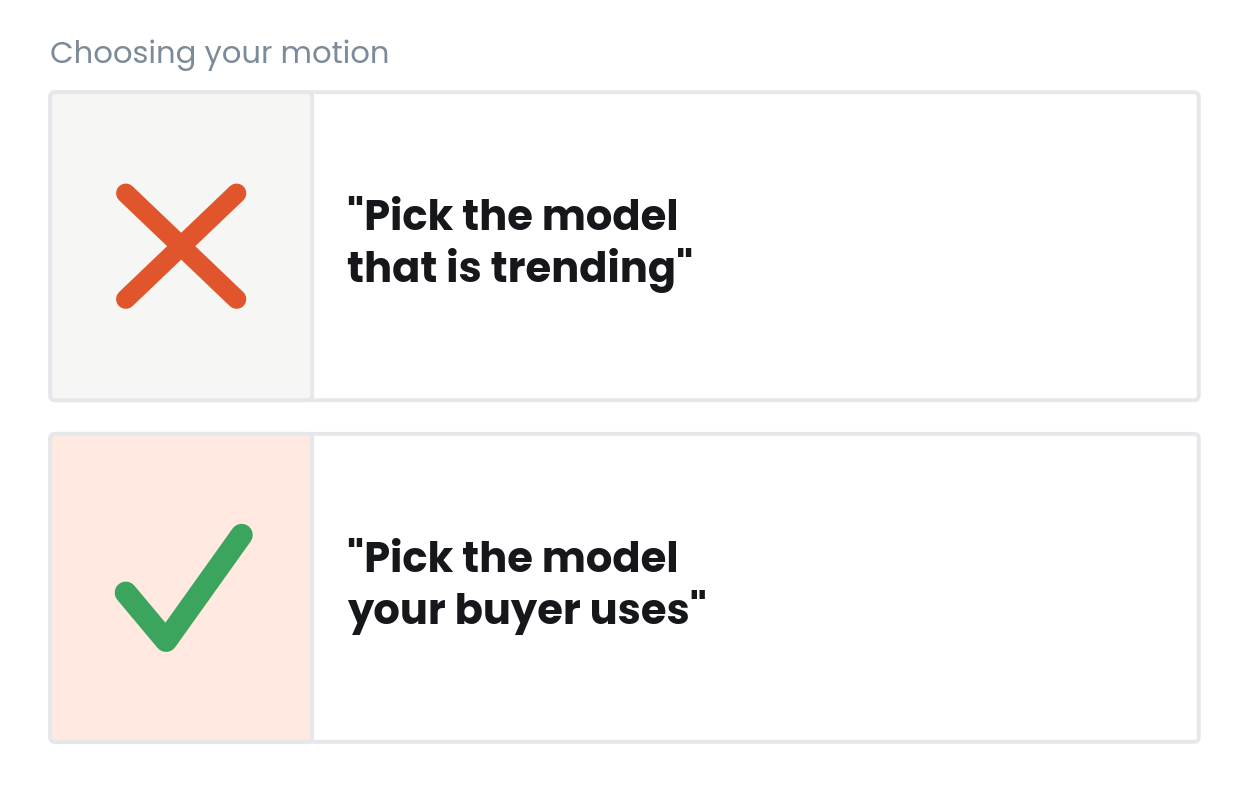
Both models win. They just win in different conditions, so the “which is better” debate is the wrong place to start.
You have seen the headlines. Product-led companies were twice as likely to double revenue in a year (OpenView, 2022). PLG-focused firms are nearly three times as likely to gain market share (Bain). Three out of four B2B software executives told Bain they worry about competition from product-led rivals.
Those numbers are real. They are also survivorship bias waiting to happen. The PLG darlings you know grew that way because their product, price, and buyer already fit a self-serve motion. Force that same motion onto a $200,000 platform that needs a three-month rollout and you will not get Figma’s growth chart. You will get silence and a very confused finance team.
So drop the “which is better” question. Ask “which one fits.” The rest of this guide is how you answer that.
Five Questions That Decide Your GTM Motion
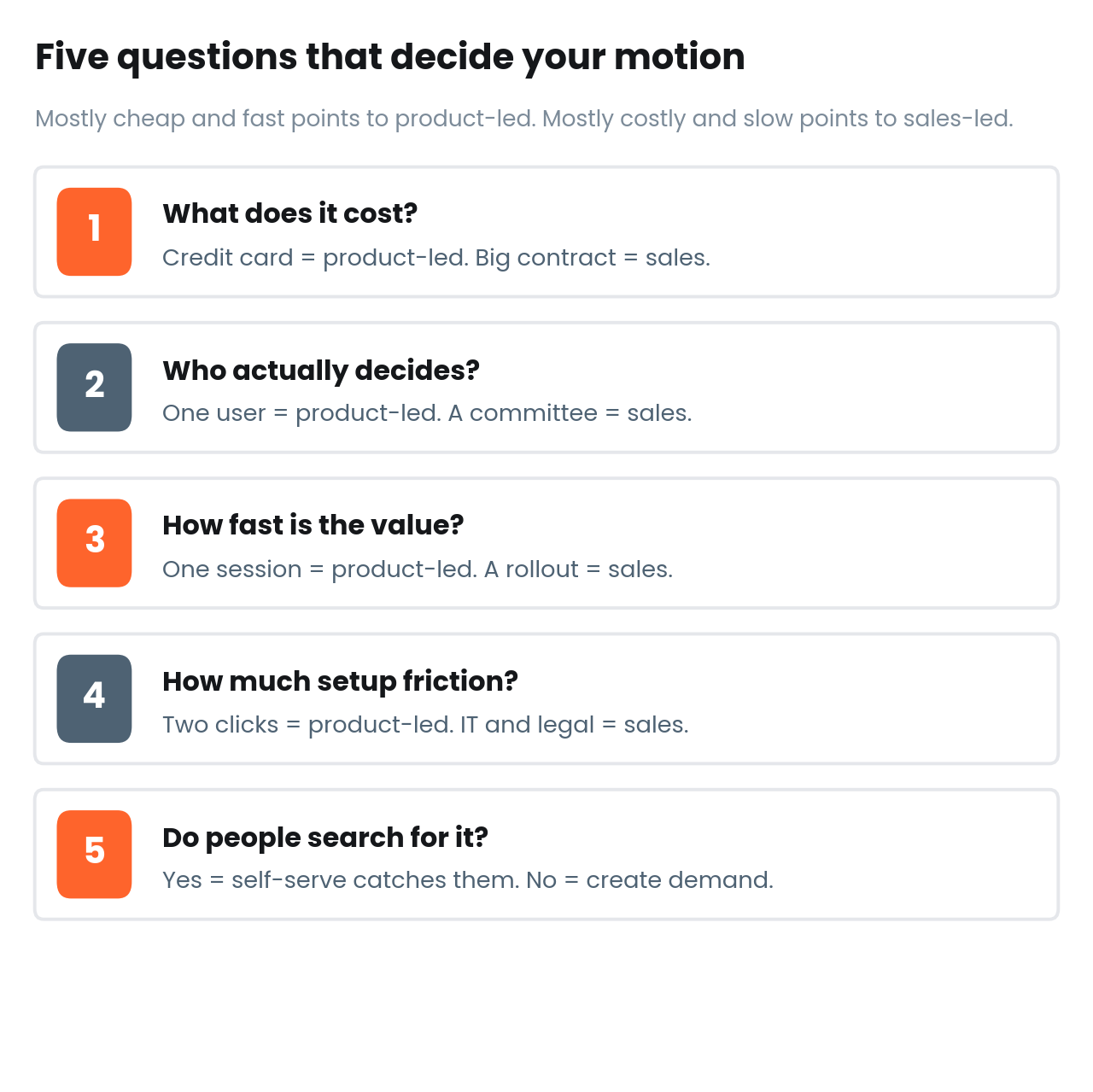
Score your product against five questions. If most answers point to cheap, fast, and self-serve, build product-led. If most point to expensive, slow, and high-touch, build sales-led. A split down the middle means you are looking at a hybrid, which I cover further down.
1. What does it cost?
Price sets the ceiling. Here is the rule of thumb: if a buyer can put it on a company credit card without asking finance, product-led is on the table. General Catalyst frames it as deals that fit under a typical credit card limit versus contracts that blow past it.
The math is simple. A salesperson costs well over $150,000 a year once you add salary, commission, and tools. To pay for that rep, each deal has to be big enough. Sell $40-a-month seats and no rep can ever close enough to justify the cost, so the product has to sell itself. Sell $80,000 contracts and a rep pays for themselves in a deal or two.
2. Who actually decides?
If the person who feels the pain can also click “buy,” product-led works. A developer adopting an API. A marketer trying a tool on a Tuesday afternoon. They find it, use it, and expense it.
When the decision needs a committee, self-serve breaks down. For a complex purchase, Gartner’s research on the B2B buying journey describes a buying group of six to ten stakeholders, each with their own goals. A signup flow cannot herd ten people, align a VP, and answer a security team. A human can.
3. How fast can someone feel the value?
Product-led growth lives or dies on the “aha” moment arriving fast. Calendly gets there in one session: share a link, someone books a meeting, you get it. That speed is what lets a stranger become a paying user without a demo.
If value takes a three-week setup, a data migration, and a training session, a stranger will not stick around to find out. Someone has to carry them through it. That someone is a salesperson or an onboarding team, which pushes you toward a sales-led motion.
4. How much friction to get started?
Count the steps between “I want to try this” and “this is working.” If it is an email and two clicks, product-led. If it is an SSO setup, a security questionnaire, an IT ticket, and a procurement form, the friction eats your self-serve funnel alive. When getting started is hard, you need a rep to clear the path, chase the security review, and keep the deal warm while legal does its thing.
5. Is the problem urgent enough to search for?
Product-led growth quietly assumes people are already looking for a fix and will find you. Sometimes they are not. Only about 5% of B2B buyers are in-market at any given moment, per Professor John Dawes at the Ehrenberg-Bass Institute, in a study he did for LinkedIn (2021).
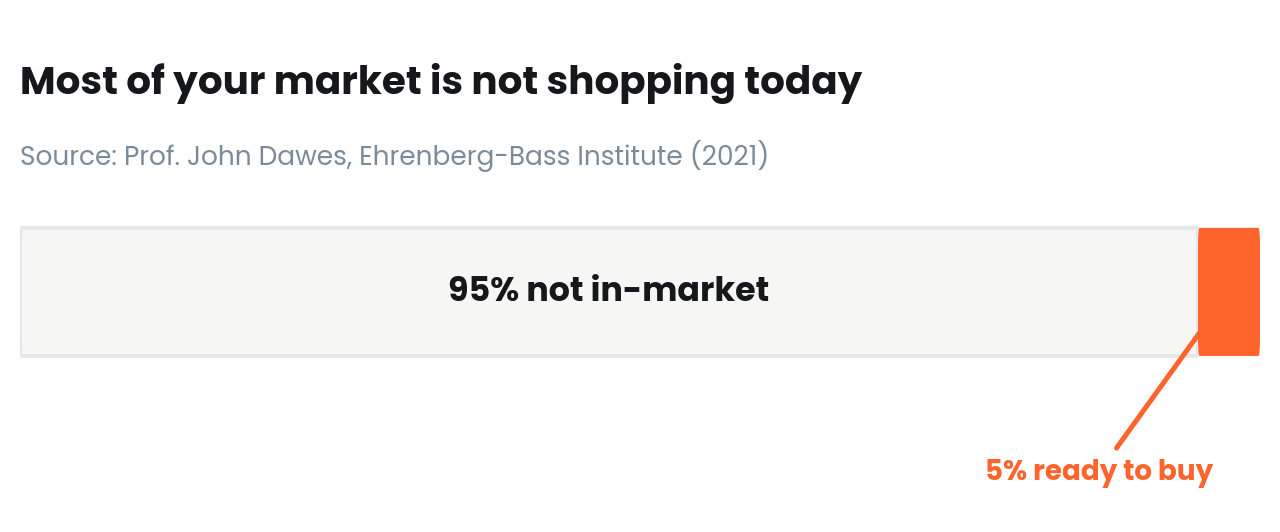
If your category is one people actively search for, self-serve captures that ready 5%. If nobody knows they have the problem yet, a product page will not wake them up. You need marketing and sales to create the demand, not just catch it.
A Worked Example: One Product, Two Motions
Here is the part that makes the framework click. Take one product and sell it two ways.
Say you built a dashboard tool that connects to a company’s data and shows trends. Same code, two very different offers.
Version A is “Starter,” $29 per user per month. It connects to Google Sheets in two clicks. One person on a team signs up to track their own numbers. Score it against the five questions: cheap, the end user decides, value in one session, almost no setup, and people search for “dashboard tool.” That is five out of five toward product-led. You would be crazy to hire a sales team to sell $29 seats one at a time.
Version B is “Enterprise,” $80,000 a year. It connects to the company data warehouse, needs a security review and a two-week setup, and is bought by a VP of Data with sign-off from IT and procurement. Score it: expensive, a committee decides, value after a rollout, heavy friction, and the buyer wants a person to answer for it. Five out of five toward sales-led. Put a self-serve checkout on this and the deal stalls at the security questionnaire.
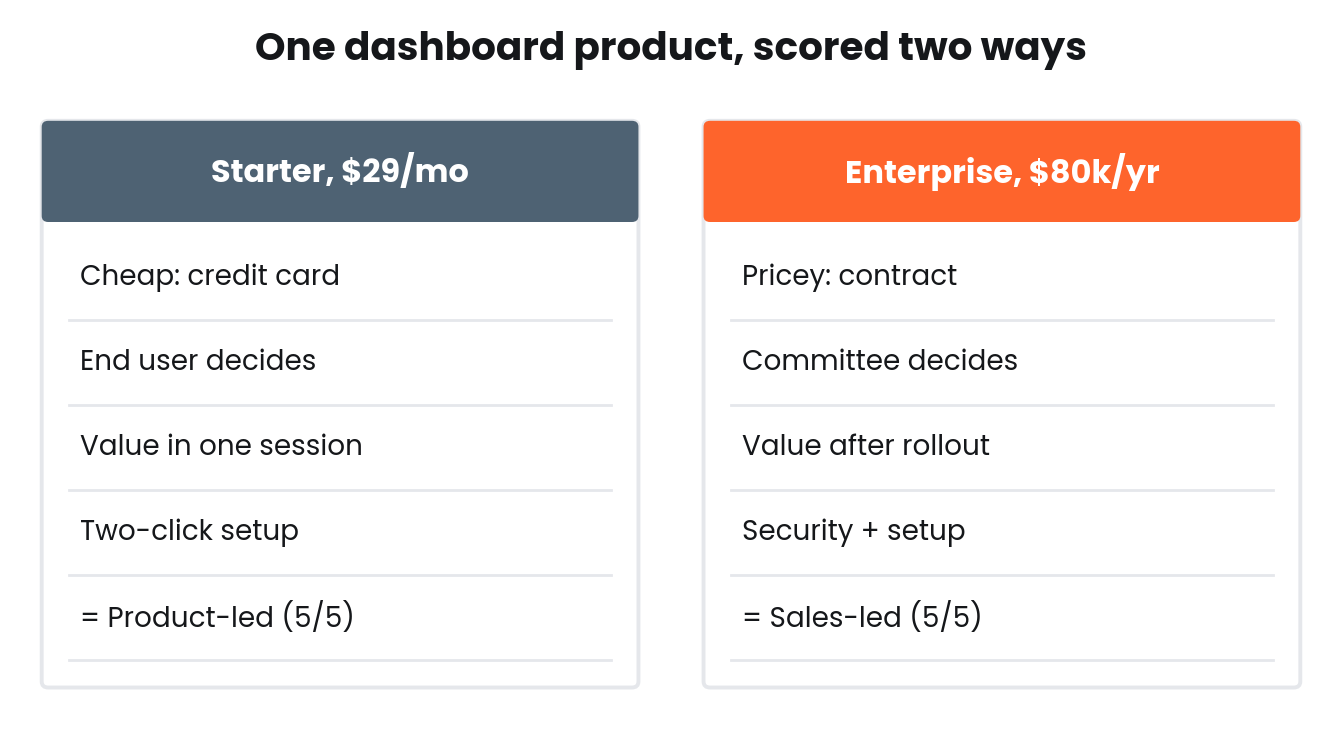
Same product. The motion flipped because the price, the buyer, and the friction changed. That is the whole point. You are not choosing one motion for your company. You are choosing it for a specific offer to a specific buyer. Which is exactly why so many companies end up running more than one.
When to Run Both: The Hybrid Motion
Most mature SaaS companies do not pick a side. They run a hybrid, usually called product-led sales, and it tends to beat either pure model on its own.
Here is how it usually goes. A company starts product-led because acquiring users that way is cheap. Individuals and small teams sign up. Then a handful of those accounts start showing real usage: ten seats, then twenty, then a whole department. That is the signal to bring in a salesperson. Not to sell from a cold start, but to expand what is already there.
Bain describes enterprise sales as a way to supercharge product-led growth rather than replace it. The product handles the top of the funnel: it acquires users and proves value cheaply. Sales handles the bottom: it turns a 15-seat foothold into a company-wide contract. After leaning into this, Dynatrace posted 15 straight quarters with net expansion above 120% (Bain). The usage data tells reps which accounts are ready, so they stop cold-calling and start expanding.
When should you add the sales layer? General Catalyst points to signals like self-serve accounts crossing about 100 employees, expanding seat counts, and inbound asks for pricing or security docs. Watch the product for those signs. Do not add a sales team on a calendar date. Add it when the data says a human can now close more than they cost.
Common Mistakes When Choosing
The most common one is copying a company you admire instead of matching your own price and buyer. Slack’s motion fits Slack’s product. Yours might not look anything like it.
A few others I see a lot. Going sales-led on a $30 product, where the deal size can never pay for the rep. Going pure self-serve on a $100,000 platform, where the buyer expects a human and a contract. Treating the choice as permanent, when the right motion shifts as you move upmarket. And adding a sales team too early, before the product has proven it can create value on its own.
Conclusion
If you take one thing from this, let it be that the motion is downstream of what you sell and who buys it. I have watched teams burn a year forcing a self-serve funnel onto a product that needed a human in the room. I have watched others hire six reps to sell a tool people would have happily bought with a credit card. Both were expensive lessons in copying the wrong role model.
So score your offer against the five questions. Be honest about your price, your buyer, and your time-to-value. Build the motion that fits, and stay ready to add a second one when your accounts start pulling you upmarket. If you want the bigger picture this sits inside, start with my go-to-market playbook guide, then get your positioning straight, because the clearest motion in the world cannot save a muddy message.
Frequently Asked Questions
What is the difference between product-led and sales-led growth?
Product-led growth uses the product as the main way to acquire, convert, and grow customers, often through free trials or freemium with self-serve checkout. Sales-led growth puts salespeople at the center, building pipeline and closing deals through demos and contracts. The main difference is who carries the deal: the product or a rep.
Is product-led growth better than sales-led growth?
Neither is better in every case. Product-led growth tends to win for low-priced products with a fast time-to-value and an end user who can buy alone. Sales-led growth wins for expensive, complex products bought by a committee. The right choice depends on your price, buyer, and product, not on which model is trendier.
How do I know if my company should be product-led?
Score five things: price, who decides, time-to-value, setup friction, and whether people search for your category. If your product is cheap, easy to start, valuable in one session, bought by the end user, and in a category people look for, product-led growth fits. If most answers point the other way, lean sales-led.
Can a company use both product-led and sales-led growth?
Yes, and most mature SaaS companies do. The common pattern is product-led sales: the product acquires users and proves value cheaply, then sales steps in to expand high-usage accounts into larger contracts. Bain describes enterprise sales as a way to supercharge product-led growth rather than replace it.
What is a good free-to-paid conversion rate for product-led growth?
Benchmarks vary, but OpenView found the median free-to-paid conversion for freemium products sits around 5%. Strong performers convert higher. If you run freemium, watch that number closely, because a small conversion rate across a large free base is the core math of the model.
When should I add a sales team to a product-led company?
Add sales when your usage data shows accounts worth a rep’s time, not on a fixed date. Common signals include self-serve accounts crossing about 100 employees, growing seat counts, and inbound requests for pricing or security reviews. At that point a salesperson expands existing value instead of selling from a cold start.
Does product-led growth work for enterprise software?
It can, but usually as the top of a hybrid motion rather than the whole thing. Individuals and teams adopt the product first, then a sales team turns that usage into an enterprise contract that clears security, legal, and procurement. Pure self-serve rarely closes six-figure deals on its own, because those buyers expect a human and a contract.
-
Demand Generation Isn't About Getting More Leads
-
How I Build a GTM Strategy Without a Huge Marketing Team
-
Why Marketing and Sales Keep Blaming Each Other.
-
The ICP vs. Buyer Persona Mistake I See All the Time.
-
What I Learned About Product Marketing After Working in B2B SaaS.
Recent posts:
Author

Rosi
Head of Marketing
Go-To-Market • Content • Growth