One customer call holds a problem post, an FAQ answer, an objection page, a comparison and a story. Here are the five questions I use to pull all of them out.
Table of Contents
Your best content ideas are already sitting in your call recordings. You just have not listened for them yet.
Introduction
You can turn one customer conversation into five content ideas by listening for five specific moments: the push that made them start looking, the exact question they asked, the worry that almost stopped them, the workaround they used before you, and the outcome they described in their own words. Each moment maps to one piece of content. One call, five pieces, all in the language your buyer actually uses.
I started doing this because I was the only marketer on the team and I was out of ideas. Not out of topics. Out of ideas that sounded like they came from someone who had met a customer. I had a list of keywords and a calendar with empty slots, and everything I wrote came out sounding like everyone else in my category.
Then I started sitting in on calls. Sales calls, onboarding calls, the odd churn conversation. I took notes on one page with five lines. Within a month the calendar was not the problem anymore. Picking which idea to write first was.
Key Takeaways
- One customer conversation can produce five content ideas if you listen for five moments: push, question, anxiety, habit and pull.
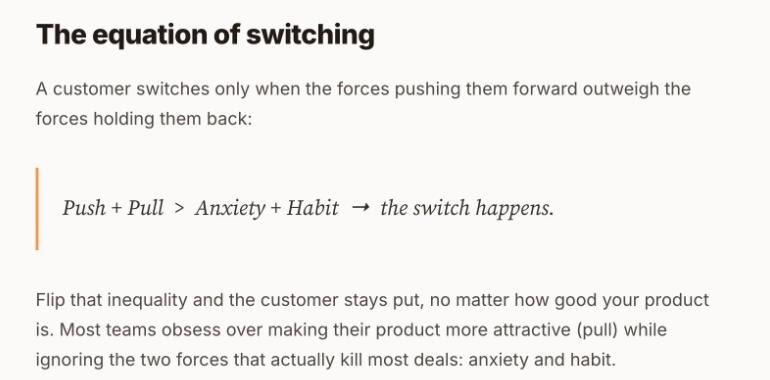
- The push, pull, anxiety and habit come from the Forces of Progress model by Bob Moesta and Chris Spiek. A switch happens when push plus pull outweighs anxiety plus habit.
- A headline lifted from a customer review beat the original by more than 400 percent in clicks in a test Joanna Wiebe at Copyhackers ran for a rehab centre.
- Gartner found in 2025 that 69 percent of B2B buyers notice inconsistencies between a vendor’s website and what its sellers tell them. Content built from calls closes that gap.
- Buyers make first contact about 61 percent of the way through their journey, per 6sense (2025). Most of their questions get answered by content, not by you.
- Content built from real conversations is first-hand by default, which is what Google’s people-first guidance asks for and what AI answer engines tend to quote.
Why customer conversations beat keyword lists
Because a keyword tells you what people type, and a conversation tells you why they typed it.
Keyword tools are useful. I still use them. But they flatten everything. “Onboarding software for small teams” could come from a founder drowning in spreadsheets or from an intern asked to make a comparison table by the end of the day. Same words, completely different post.
A conversation gives you the situation around the words. Who was in the room. What broke. What they were scared of. What they had already tried. That context is the part your competitors cannot copy, because they were not on the call.
There is also a timing reason. 6sense surveyed nearly 4,000 B2B buyers in 2025 and found they make first contact with a vendor about 61 percent of the way through their buying process. Most of the questions get asked and answered before anyone talks to you. The content they find in that stretch is doing your sales job. It might as well be built from the questions real buyers actually ask.
The framework: five moments in every customer conversation
The five moments are push, question, anxiety, habit and pull. Four of them come from the Forces of Progress, a model Bob Moesta and Chris Spiek built to explain why customers switch from one way of doing things to another. The fifth, the exact question, is the one I added because it is the easiest to turn into content that ranks and gets cited.
Think of a customer call like a receipt. The product is the line at the bottom. Everything above it is what they paid in effort, doubt and time to get there. The content lives above the line.
Here is what I listen for, and what each one turns into.
1. The push: what broke
The push is the moment the old way stopped being acceptable. Not “we wanted to grow.” Something specific. A report that took three people two days. A client who left. A board member who asked a question nobody could answer.
The question I ask: “What was happening the week you started looking?”
What it becomes: a problem post. You describe the broken moment in the buyer’s words, then explain why it happens. You do not pitch. People who are living that moment will recognise it and keep reading, and people who are not there yet will remember it when they are.
2. The exact question: what they typed
At some point in every call, the buyer asks a question out loud. “Can this work if our data is in three places?” “How long until my team actually uses it?” Write it down word for word. Do not tidy it.
The question I ask: “What did you search for, or ask a colleague, before you found us?”
What it becomes: an FAQ answer or a short answer page. Use the question as the heading and answer it in the first sentence. This is the format search engines and AI answer engines lift most easily, because it is already a clean question and answer pair.
3. The anxiety: what almost stopped them
Anxiety is the fear about the new thing. Will it take longer than they said? Will my team hate it? Will I look stupid if it fails? Buyers rarely say this to a salesperson unprompted. They will say it on an onboarding call, after the deal is signed, when it is safe.
The question I ask: “What almost made you not do this?”
What it becomes: an objection post. Name the fear directly and answer it with something concrete: a number, a timeline, a story of it going wrong and what happened next. Most vendors avoid writing about the fears. That is exactly why the post that does will get read.
4. The habit: what they did before you
Habit is the pull of the current way. Usually it is a spreadsheet, a freelancer, an old tool nobody likes but everyone knows, or doing nothing at all. Your real competitor is often not another vendor. It is the workaround.
The question I ask: “What were you doing instead, and what was good about it?”
The second half of that question matters. The workaround always had something going for it. Cheap, familiar, no training. If you do not name that honestly, the buyer will not trust the rest.
What it becomes: a comparison post. Not “us vs competitor X” but “us vs the spreadsheet.” An honest page about when the old way is still fine, and the point where it stops being fine.
5. The pull: what good looks like, in their words
Pull is the picture of life after the switch. Listen for the sentence the customer says when they describe the result. It is almost never your tagline. It is usually smaller and more vivid. “I stopped dreading the first week of the month.” “I can answer the CEO without opening my laptop.”
The question I ask: “What is different now that you would not want to give up?”
What it becomes: a story or a point of view post. Either a short before and after, or a take that pushes against how your category usually talks about the outcome. That second option matters more than it looks, and I come back to it below.
Why their words beat your words
Because buyers recognise themselves in their own language, and they skim past yours.
The clearest proof I know is a test that conversion copywriter Joanna Wiebe ran years ago for a rehab centre. She read through hundreds of book reviews on Amazon, wrote down the phrases that repeated, and pulled one line straight from a reviewer: “If you think you need rehab, you do.” It replaced a headline the team had written themselves.
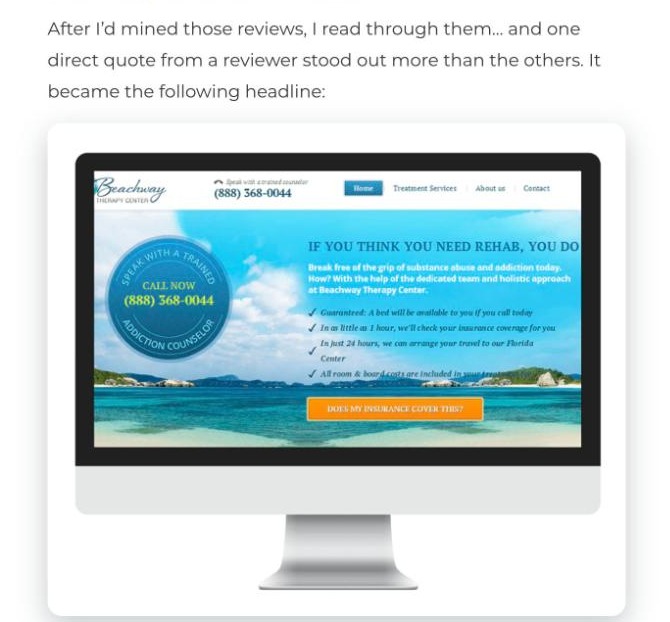
According to Copyhackers, the customer’s line got more than 400 percent more clicks on the main button than the original, and more than 20 percent more form submissions on the next page. Nobody on the team would have written that sentence. It was too blunt. That was the point.
Review mining is the same idea as what I do on calls, just with strangers instead of customers. A call is better, though. You can ask a follow-up question. A review cannot answer you.
The consistency problem this quietly fixes
When your content comes from what customers say on calls, your website starts to sound like your sales team. That turns out to matter a lot.
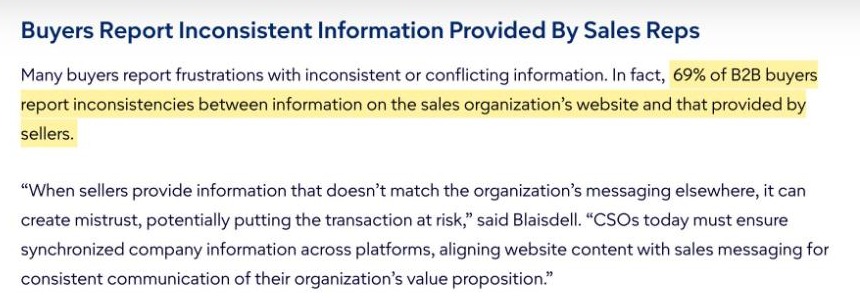
In a survey of 632 B2B buyers, Gartner found 69 percent had noticed the vendor’s website saying one thing and its sellers saying another. The same survey found 61 percent of buyers would rather buy without a rep at all. Put those two together and the website is carrying most of the conversation, and often carrying a different one.
Most of that gap comes from the website being written in a meeting room and the sales pitch being shaped by real calls. If both are built from the same calls, the gap closes on its own. It is one of the less obvious reasons marketing and sales stop blaming each other once marketing starts showing up to calls.
Why this content gets found and cited
Because it is first-hand, and first-hand content is exactly what search engines and AI answer engines are trying to reward.
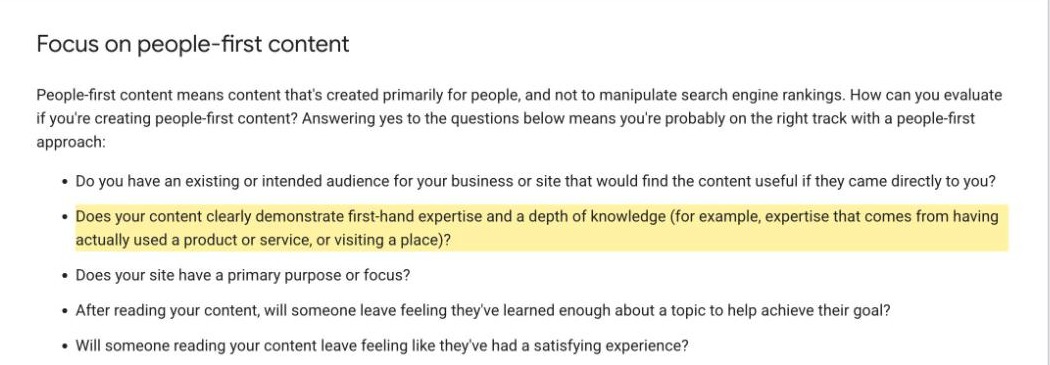
Google’s guidance on helpful content lists the questions it wants creators to ask themselves. One of them is whether your content clearly shows first-hand expertise and depth of knowledge. Another asks whether it offers original information that is not already on other websites. A keyword-led post rewritten from the top ten results fails both. A post built from what a customer told you last week passes both without trying.
The exact question format helps with AI search too. When a page has a real question as a heading and a direct answer underneath, it is easy for an engine to lift that pair into a generated answer. You are writing the snippet for them.
The pull post is where the point of view lives
The fifth idea is the one most teams skip, and it is the one with the most upside.
When a customer describes what good looks like, they often contradict the way your category talks. The category says “save time.” The customer says “I stopped being the bottleneck.” The category says “all in one platform.” The customer says “I liked that it did one thing and left me alone.”
That contradiction is a point of view, handed to you for free.
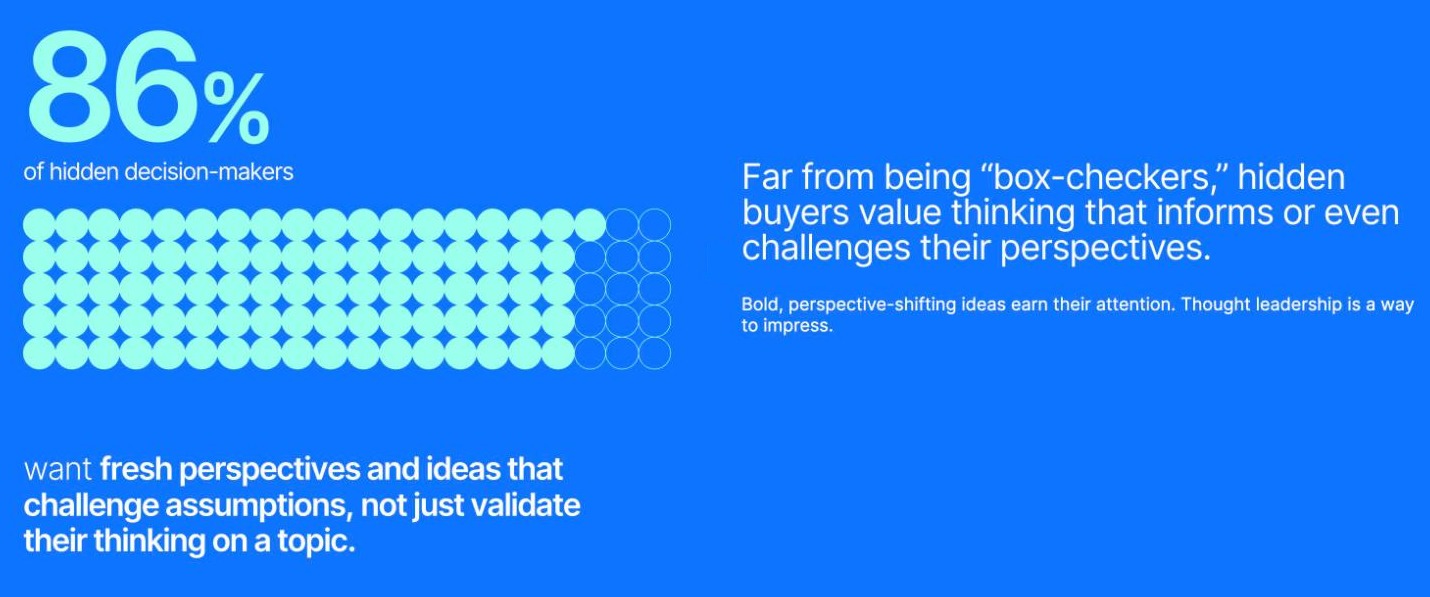
The 2025 Edelman-LinkedIn B2B Thought Leadership Impact Report, based on a survey of 1,934 business decision makers, found 86 percent of hidden decision-makers want fresh perspectives and ideas that challenge assumptions, not content that just confirms what they already think. Those are the people in finance, legal and procurement who never get on a call with you but can still stop the deal.
You cannot invent a fresh perspective in a brainstorm very often. You can hear one on a call every week if you are listening for the gap between what customers say and what the market says.
A worked example: one call, five ideas
Here is what the five-line note looks like in practice. This is a composite of a few onboarding calls, with details changed, for a fictional tool that helps small finance teams close their books each month.
Push: “Our controller was out sick during close and nobody else knew where anything lived. We closed six days late. That was the week I started looking.”
Exact question: “Can this work if half our invoices still come in as PDFs by email?”
Anxiety: “I was scared we would spend two months setting it up and then go back to the spreadsheet anyway, and I would have to explain that.”
Habit: “Honestly, the spreadsheet was fine. Everyone knew it. The problem was it only lived in one person’s head.”
Pull: “Now if someone is out, close still happens. I am not the person everyone waits on.”
And here are the five content ideas that came out of it:
- Problem post: “Your month end close has a single point of failure, and it is a person.” Built around the sick-day story.
- Answer page: “Can you automate month end close if invoices arrive as PDFs by email?” Question as the heading, direct answer in line one, then the detail.
- Objection post: “What happens if you set up close software and your team goes back to the spreadsheet?” Name the fear, then show the realistic timeline and what makes adoption stick.
- Comparison post: “Close software vs a well kept spreadsheet: when the spreadsheet is still the right call.” Honest about where the old way wins.
- Point of view post: “The real cost of month end is not time. It is being the person everyone waits on.” The customer’s pull line, turned into a take the category does not usually make.
Five briefs. One call. None of them started with a keyword tool, though I would check each one against search data before writing it to pick the right phrasing for the title.
How to run the call so the five moments show up
Ask about the past, not the future. People are bad at predicting what they will do and very good at describing what already happened. “Would you use a feature that…” gets you a polite yes. “Tell me about the last time close went wrong” gets you a story.
A few things that help:
- Get the timeline first. Ask when they first thought about changing, then what happened next, then next. The five moments show up naturally in order.
- Write down exact phrases, not summaries. “Customer frustrated with manual process” is useless. “Nobody else knew where anything lived” is a headline.
- Ask “why” one more time than feels polite. The first answer is usually the rational one. The second is the real one.
- Talk to recent customers. The switch has to be fresh. Someone who bought two years ago has rewritten the story in their head.
- Mix in a lost deal now and then. The anxiety and habit moments are loudest in people who almost bought and did not.
If you cannot get on sales calls, onboarding and customer success calls work almost as well, and recordings plus a transcript are fine. You will get more out of five recorded calls you actually listen to than fifty you have tagged and never opened.
It also helps to know who you should be listening to in the first place. If the calls are with the wrong kind of customer, the content will attract more of them. I wrote about the difference between an ICP and a buyer persona for exactly that reason.
Conclusion
You do not need a content strategy offsite to fill a calendar. You need one good conversation a week and a page with five lines on it.
Listen for what broke, what they asked, what scared them, what they did before and what good looks like now. Write each one down in their words. Then turn each line into one piece. The content will sound like your customers, match what your sales team says, and carry the kind of first-hand detail that search engines and AI answers keep looking for.
Start with the next call already on the calendar. Bring the five questions. See how many of the lines you can fill.
Frequently Asked Questions
How do you turn customer conversations into content?
Listen for five moments in the conversation: the push that made the customer start looking, the exact question they asked, the worry that almost stopped them, what they used before, and how they describe the result. Write each one down in their exact words. Each moment becomes one content idea: a problem post, an answer page, an objection post, a comparison post and a point of view post.
What questions should you ask customers to get content ideas?
Ask about things that already happened. Good questions are: what was happening the week you started looking, what did you search for before you found us, what almost made you not do this, what were you doing instead and what was good about it, and what is different now that you would not want to give up. Past behaviour gives you stories. Hypothetical questions give you polite guesses.
What are the four forces of progress?
The four forces of progress are push, pull, anxiety and habit, a model developed by Bob Moesta and Chris Spiek as part of Jobs to be Done. Push is the problem with the current situation, pull is the attraction of the new solution, anxiety is the fear about the new solution, and habit is the comfort of the old way. A customer switches only when push plus pull is greater than anxiety plus habit.
What is voice of customer content?
Voice of customer content is content built from the exact words customers use to describe their problem, their decision and the result. It often outperforms copy written by the team. In one test by Copyhackers, a headline taken word for word from a customer review got more than 400 percent more clicks than the original.
How many customer calls do you need to plan content?
Fewer than most teams expect. One well run conversation can give you five ideas, so four calls a month can fill a weekly publishing calendar. Patterns start to show after five to ten calls, which is when you can see which pushes and worries repeat across customers and deserve a cornerstone piece.
Is content from customer calls good for SEO and AI search?
Yes. Google’s helpful content guidance asks whether content shows first-hand expertise and offers original information not available elsewhere, and content built from your own customer conversations does both. Real questions used as headings with a direct answer underneath are also easy for AI answer engines to quote.
Can you use customer quotes in content without permission?
Treat it carefully. Using the general theme of what customers say is normal practice, but quoting a named customer or a recognisable company needs their permission. When in doubt, paraphrase, remove identifying details, or ask. Most customers say yes when you show them the line and where it will appear.
-
How I Know When I'm Targeting the Wrong ICP.
-
Demand Generation Isn't About Getting More Leads
-
How I Build a GTM Strategy Without a Huge Marketing Team
-
Why Marketing and Sales Keep Blaming Each Other.
-
The ICP vs. Buyer Persona Mistake I See All the Time.
Recent posts:
Author

Rosi
Senior B2B Marketer • AI-native | GTM • Content • Growth