A packed pipeline can still mean the wrong ICP. Here are the six signals I check before blaming sales, and exactly how I fix the targeting once I find them.
Table of Contents
A full pipeline can still mean a broken ICP. Here is how I check, before I let anyone blame the sales team for it.
Introduction
Here is a pattern I have seen at more than one company. Pipeline looks healthy. The team is hitting its meeting-booked number. Sales closes deals every month. And then, a couple of quarters later, revenue is flat, because almost everyone who signed up in that window has quietly stopped using the product, downgraded, or churned outright.
Nobody missed their number. Marketing hit its lead target. Sales hit its closed-won target. And the business still didn’t grow, because the accounts being won were never going to get enough value to stay. That is what a wrong ICP looks like from the inside. It does not show up as a missed quota. It shows up a few months later, as a pattern of departures that nobody tied back to the targeting decision that caused them.
The problem is that your ideal customer profile can be wrong without anyone noticing for a long time, because the first numbers that break are churn and expansion, and those lag the deal by a quarter or two. By the time the pattern is obvious, you have already spent a few quarters of budget acquiring the wrong accounts. This post is the checklist I actually use to catch it earlier: six signals that your ICP has drifted off target, a worked example of what the math looks like when it has, and the fix, which is almost always smaller and faster than people expect.
Key Takeaways
- A wrong ICP shows up late, not early. It rarely breaks your pipeline number. It breaks churn, support load, and renewal expansion, usually one to two quarters after you started winning the account.
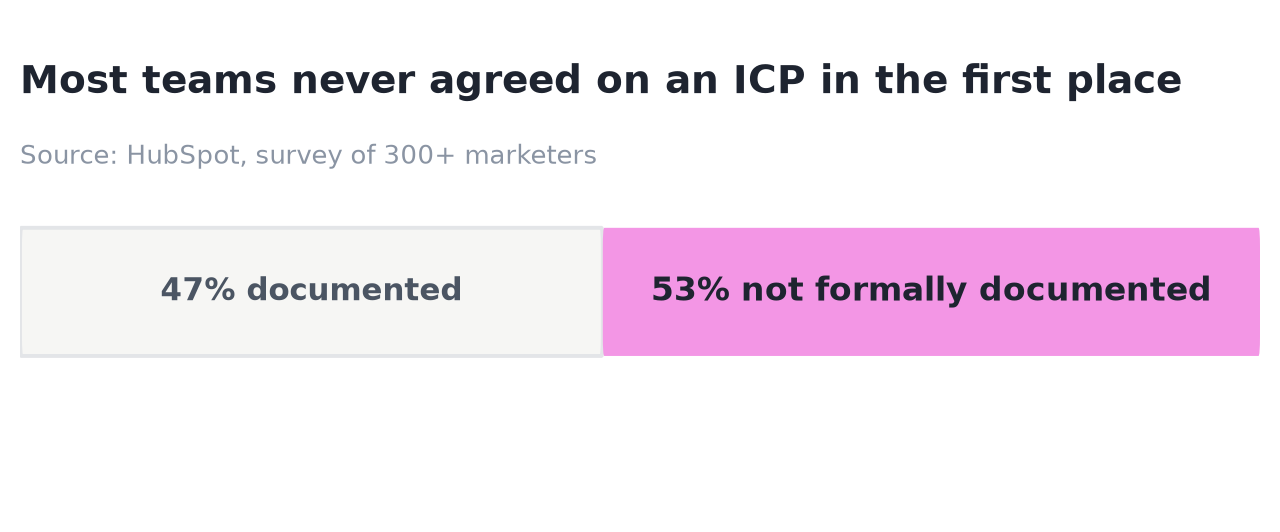
- Most teams don’t have a documented ICP to drift from. Over half of marketers surveyed by HubSpot say their ICP is not formally documented, which means there is no fixed target to check against in the first place.
- Fit problems are the top reason startups die. CB Insights found poor product-market fit behind 43% of the 385 recent VC-backed failures it was able to identify a cause for, ahead of running out of cash.
- Win rate alone tells you almost nothing about fit. A team can close plenty of deals it should have walked away from, and the close rate will look fine right up until the renewal date.
- The cheapest diagnostic is splitting churn by account trait, not by lead source. Tag each lost or flat account by size, industry, and use case, and the wrong-fit cluster usually shows itself within a quarter of data.
- Fixing a wrong ICP is subtraction, not addition. You are narrowing who you spend money reaching, not inventing a new segment from scratch.
Sign 1: Your Best Customers Don’t Look Like Your Average Customer
Pull your highest-NRR accounts, the ones that expand every renewal and never file a basic support ticket, and look at what they have in common. If that list looks nothing like the accounts you are closing today, your targeting has moved away from your actual ideal customer profile, even if nobody changed it on paper.
This happens gradually. A rep closes a deal slightly outside the usual profile because the quarter is tight. Marketing widens an ad audience because cost per lead crept up. Each decision is small and reasonable on its own. None of them get checked against the list of accounts that are actually working, because that list takes real analysis to pull and nobody owns the job of pulling it every quarter.
The fix starts with a simple exercise. Rank your current customers by net revenue retention or by a direct proxy like renewal rate, take the top 20%, and list every firmographic trait they share: headcount band, industry, the tool they replaced, the trigger event that brought them in. That list is closer to your real ICP than whatever is written in last year’s sales deck.
Sign 2: Deals Take Longer to Close Than They Used To, and Nobody Can Say Why
A stretching sales cycle, with the same team, the same product, and the same pricing, is usually a targeting problem wearing a sales-execution costume. Right-fit buyers already feel the pain your product solves, so they move. Wrong-fit buyers have to be convinced the pain exists before they can be convinced you solve it, and that education step is what adds weeks to a deal.
Check this by segment, not in aggregate. If your overall average sales cycle is flat but one segment has quietly stretched from 30 days to 90, that segment is where your targeting has drifted, even though the blended number looks stable. Sales will usually describe this as “more stakeholders getting involved” or “longer procurement,” which are true descriptions of what is happening and the wrong explanation for why it is happening.
Sign 3: Support Keeps Explaining the Same Basic Thing to Different Customers
When a disproportionate share of support tickets are not bugs but questions about what the product is for and how to get it to do the thing it was bought to do, that is a fit signal, not a training gap. Customers who match your ICP tend to arrive with the right context already, because the problem your product solves is one they were actively trying to solve. Customers outside your ICP often buy because the deal got closed, not because the fit was obvious to them on day one, so the basics have to be explained after the contract is signed instead of before it.
If you track ticket category, run this check: compare basic-usage ticket volume per account, segmented by the same firmographic traits you use in Sign 1. A cluster of accounts that need the fundamentals re-explained every few weeks is very often the same cluster that churns at renewal.
Sign 4: Nobody on the Team Can Describe the ICP the Same Way Twice
Ask three people on your team, separately, to describe your ICP in one sentence. If you get three different answers, you do not have an ICP problem you can fix with better filtering, because you do not actually have an ICP. You have three informal, slightly different ones, each shaping a different part of the funnel.
This is more common than it should be. Marketing is often targeting the segment that is cheapest to reach. Sales is often chasing whatever will close fastest this quarter. Customer success is often forming its own opinion from whoever is loudest in a renewal call. None of these are wrong inputs, but without a single written profile that all three groups check against, each team quietly optimizes for a slightly different buyer, and the accounts you end up with are the union of three mismatched filters rather than the output of one good one.
If you want the fuller breakdown of how an ICP differs from the buyer personas inside it, I wrote about that distinction in ICP vs. buyer persona. The short version for this post: write the ICP down, in one page, with the traits from Sign 1, and make every team check new targets against that page before the next campaign or outbound list goes out.
Sign 5: Expansion Revenue Comes From a Narrower List Than New Logos
Look at where your expansion and upsell revenue actually comes from this year. If it is concentrated in a small, specific slice of your customer base, while new logo acquisition is spread across a much wider range of company types, that gap is your targeting problem made visible. The narrow slice is close to your real ICP. The wide spread is everyone else you are currently spending money to acquire.
This signal is useful because it is hard to argue with. Pipeline and win rate can be shaped by a strong quarter from a single rep or a one-off marketing push. Expansion revenue is harder to fake, because it requires a customer to keep paying you more money after they have already used the product for a while and know exactly what it does. A account base that does not expand is telling you, in the most direct way it can, that it is not getting enough value to want more.
Sign 6: Win Rate Drops the Further You Get From One Specific Profile
Segment your win rate by the same traits again: company size, industry, the tool you are replacing. A healthy ICP usually shows a sharp win-rate cliff, high win rate inside a specific band, and a clear drop just outside it. If your win rate is roughly flat across every segment you sell into, that is not good news. It usually means your product doesn’t have a strong, specific fit anywhere, or your team has stopped qualifying against any profile at all and is simply working whatever shows up.
The B2B research group at Gartner found that a typical B2B purchase now involves six to 10 decision makers. Outside your real ICP, you are convincing that whole group of people who were never going to feel the pain as sharply, which is a slower and more expensive version of a sale you were never well positioned to win.
A Worked Example
Say you sell a project management tool and have been selling it to both small agencies, under 20 people, and mid-market companies with established project teams. Here is what the account math tends to look like once you split the two groups honestly.
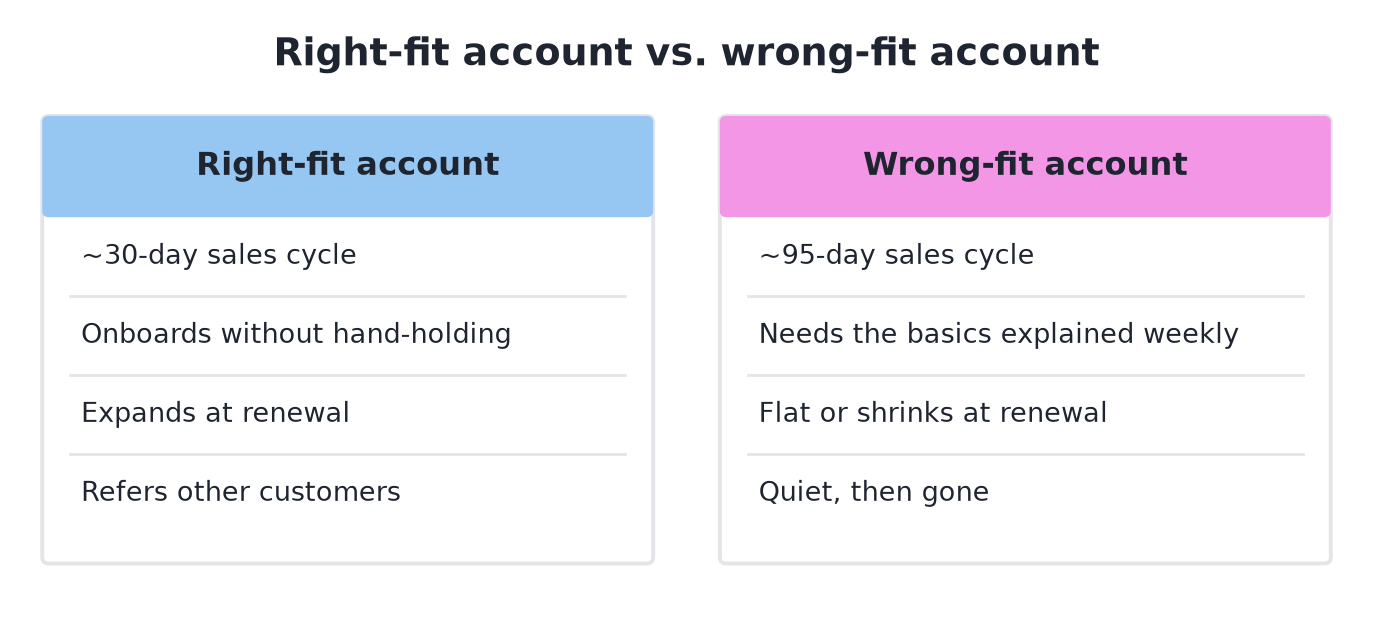
Mid-market accounts with a dedicated project manager already run some version of a process your tool fits into. They close in around a month, onboard themselves using your existing documentation, and expand seats at renewal because the tool becomes part of how a growing team coordinates work. Small agencies without a dedicated process owner take three times as long to close, because someone has to be convinced a formal tool is worth the switch from a shared spreadsheet. They need the basics walked through repeatedly after signing, and a large share go quiet before the next renewal, because the tool was a nice-to-have nobody internally was pushing for.
Both groups technically “fit” a broad definition of your market. Only one of them is your ICP. The other group is not worthless, some of those agencies will be great customers, but as a segment, it costs roughly three times as much sales effort to win and converts to a worse long-term account. That is the gap a tight ICP is supposed to catch before the deal is signed, not after.
How to Fix a Wrong ICP Without Starting Over
Fixing this is rarely a full reset. It is closer to narrowing a filter than rebuilding the whole engine.
- Write down the traits of your top 20% by retention, from Sign 1. That is your draft ICP, built from evidence instead of a guess.
- Re-score your current pipeline against it. Not to kill deals mid-cycle, but to see what share of your active pipeline is in-profile versus out, so you know how big the drift actually is.
- Move spend before you move messaging. Cut ad audiences, outbound lists, and content topics aimed outside the new profile first. The targeting gap closes faster from the top of the funnel than from a messaging rewrite.
- Give sales a real qualification question, not a vague rule. “Is this a mid-market company with a dedicated project owner” is something a rep can check in a first call. “Target growing companies” is not.
- Re-check quarterly, using the quarter’s actual closed-won and closed-lost data. An ICP built once and never revisited goes stale at the same rate your market moves.
None of this requires a new product, a new positioning document, or a new team. It requires looking at who already sticks around, and being willing to spend less time and money chasing everyone else. If the segment you build your go-to-market plan around is the wrong one, no amount of execution further down the funnel fixes that. Fix the filter first.
Conclusion
A wrong ICP rarely announces itself. It hides behind a healthy pipeline number for a quarter or two, then shows up as churn, flat renewals, and a support team explaining the same basics over and over. The six signals here, mismatched best customers, lengthening sales cycles, repetitive support load, a team that can’t agree on who the ICP even is, narrow expansion revenue, and a flat win rate across segments, are all ways of catching that drift before it costs you another quarter of budget.
The fix is not a rebuild. It is writing down who is actually working for you, checking your current pipeline against that list, and moving spend away from everyone else. Most teams never do this because it means admitting some of the deals on the board right now are the wrong ones to be chasing. The teams that do it anyway are the ones that stop having this same conversation every two quarters.
Frequently Asked Questions
How do you know if you’re targeting the wrong ICP?
Look at what happens after the deal closes, not just whether it closes. If win rate holds steady but the accounts you win onboard slowly, open constant support tickets, and don’t expand at renewal, you are closing deals outside your real ideal customer profile. The clearest single signal is churn and expansion split by account trait, not the shape of your pipeline.
What is the fastest way to spot a wrong ICP without new data?
Pull your logo churn and expansion revenue from the last four quarters and tag each account by the traits you used to sell to them: size, industry, use case. If churn and flat renewals cluster on a handful of traits, that cluster is your actual wrong-fit profile, whether or not it matches what the team says the ICP is.
Can a company have the wrong ICP and still hit its pipeline number?
Yes, and this is the trap. A wrong ICP shows up first in close rate and retention, not in top-of-funnel volume. A team can beat its lead and pipeline targets for two or three quarters while quietly filling the base with accounts that churn, because marketing and sales are both measured on activity that happens before the mismatch becomes visible.
How often should you re-check your ICP?
Once a quarter at minimum, using closed-won and closed-lost data from the quarter before, not once a year in a planning offsite. Markets, pricing, and your own product move faster than an annual review can track, and a stale ICP is worse than no ICP, because the team still trusts it.
What’s the difference between losing a deal and losing to the wrong ICP?
Losing a deal means a specific prospect said no. Targeting the wrong ICP means you are winning deals that should have been losses, because the account was never going to get enough value to stay. The second problem is more expensive, since it shows up as churn and support cost months after the win gets celebrated.
Does a wrong ICP affect marketing as much as sales?
More, usually, because marketing sets the top of the funnel that sales has to work from. If marketing’s targeting criteria are broader than the real ICP, every list, ad audience, and piece of content pulls in a mix of right-fit and wrong-fit prospects, and sales ends up compensating for a targeting decision it didn’t make.
-
How I Turn One Customer Conversation Into Five Content Ideas
-
Demand Generation Isn't About Getting More Leads
-
How I Build a GTM Strategy Without a Huge Marketing Team
-
Why Marketing and Sales Keep Blaming Each Other.
-
The ICP vs. Buyer Persona Mistake I See All the Time.
Recent posts:
Author

Rosi
Senior B2B Marketer • AI-native | GTM • Content • Growth